
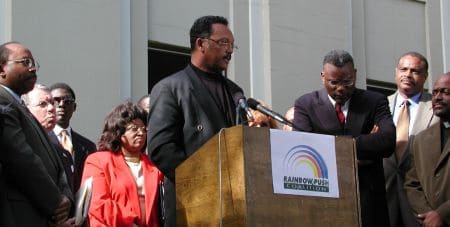
Inclusion is the Key to Growth- EB-5 Reflections from the Late Reverend Jesse Jackson.
On February 17, 2026, the United States of America and the world alike, lost a predominant moral voice. The Reverend Jesse L. Jackson, Sr., not only a civil rights leader but a two-time presidential candidate and founder of the Rainbow PUSH coalition, passed away at the age of 84. For anybody who had the privilege of working with Reverend Jackson, that loss is personal.
In February 2017, we were honored to welcome Reverend Jackson as a guest on our Podcast show, Global Investment Voice. Originally, we invited him to discuss the work the Reverend was compiling as part of the Rainbow/PUSH Wall Street Economic Summit, and its connection to EB-5 in serving American communities. However, the conversation grew into something much larger. In the context of the first Trump administration’s travel bans, he discussed a vision of what America can be when openness and growth are chosen over fear and exclusion. As we reflect on his words and sentiment, that conversation feels more relevant today than ever before.
“Inclusion is the Key to Growth”
Perhaps the most powerful words Reverend Jackson shared with us that day were simple but profound “Inclusion is the key to growth”. In both the political climate of then and today, the words carry a quiet radicalism. He stated this in reference specifically to investment in Black and Brown urban communities, which have long been starved of capital, not just in New York but across America. However, the meaning is broader. He believed, as do we, that the strength and future of America does not lie in homogeneity, but in its unique diversity. The rainbow coalition is one of the country’s greatest assets.
That day, he spoke of why he was drawn to EB-5, and what he called the ‘surplus’ and the ‘deficit’ culture in relation to individuals who have too much and individuals who have too little. The argument was not of charity but of economics. Globalizing capital without globalizing human rights, workers’ rights, and investment opportunity, he said, was a fundamental contradiction. When the playing field is uneven, when the rules are not transparent, and when the referees are not impartial, nobody truly wins.
At the time of the episode recording, an executive order had just been signed by President Trump, which restricted immigration from several Muslim-majority countries. Reverend Jackson was direct, drawing a line from ships of Jewish refugees turned away from American shores in WW2 to the airport detentions being witnessed at the time.
“Jesus was a refugee… To turn away refugees is immoral”.
He provided that the promise inscribed on the Statue of Liberty, give me your tired, your poor, your huddled masses yearning to breathe free is what defines the American character, not an executive order.
These words spoken nearly a decade ago by Jackson on our podcast, Global Investment Voice, unfortunately, resonate with a painful familiarity today. As we have written about in January 2026, the Trump administration froze immigrant processing for nationals of 75 countries. A vast list including Latin America, Africa, the Middle East, and beyond. The stated justification surrounds itself on “public charge” concerns, but the order prohibits not just vital investors for America’s economy but families waiting to reunite, all without individual assessment.
The vast majority of excluded countries are predominantly non-white. The message being sent to investors and the world now, just as then, is the same Reverend Jackson warned against… Exclusion disguised as policy.
Unlike those in Washington, as an immigration law firm, we see the cost of these policies not just on individual families but on America. Wealthy investors willing to make a difference in American communities are denied the opportunity to contribute to the economy. Alongside this, talented individuals have been redirected to other countries that happily embrace their investments. This is what Jackson saw clearly: “There are some unfounded fears about immigrants… they have been the source of growth.”
A shared vision of EB-5 as an Engine of Inclusion.
Reverend Jackson and his work with Rainbow/PUSH were a natural conversation partner for an EB-5 firm; his understanding that capital, which is directed with intention, can heal and transform communities was paramount. He spoke of non-white communities in New York and across America with vacant homes, closed schools, and aging infrastructures. He, like us, saw these as opportunities ripe with potential for investors.
“It’s an absolute marriage for EB-5”. Reverend Jesse Jackson saw the EB-5 Immigrant Investor Program as a mechanism for economic inclusion, not just a niche immigration tool. The program’s job creation requirements benefit underserved communities through injections of capital to rebuild businesses and infrastructure. It’s a straightforward alignment. These communities are not charity cases but undercapitalized markets. With vacant housing and aging infrastructure representing unrealized economic value. Directing EB-5 investment into these areas through TEA zones is commercially rational and socially responsible.
Inclusion in today’s market requires access to capital. If growth follows investment, then it’s essential to broaden the recipients of investment to broaden the recipients of growth. EB-5 programs used intentionally can shift capital towards communities excluded from it, turning immigration investment into a tool of domestic renewal. It’s easy to forget that EB-5 projects aren’t always luxurious hotels.
To honor Reverend Jackson’s legacy is to continue the fight for the values he steadfastly believed in. For those of us working within investment immigration, the clearest way to do that is to protest loudly and consistently that inclusion is the engine of growth, as Reverend Jackson put it with characteristic simplicity, the key.
Reverend Jesse L. Jackson passed peacefully at 84 years old. He was one of the central architects of modern American Civil rights politics. A protégé of Martin Luther King Jr., he carried the movement from the streets to structures of power. He ran for presidency twice and, as later acknowledge by Barack Obama, made possible a different political future for America.
We invite you to listen to our original conversation with Reverend Jackson, alongside our tribute episode honoring his life and legacy.
Photo: Wayne Denmark / Wikimedia Commons (Public Domain)