
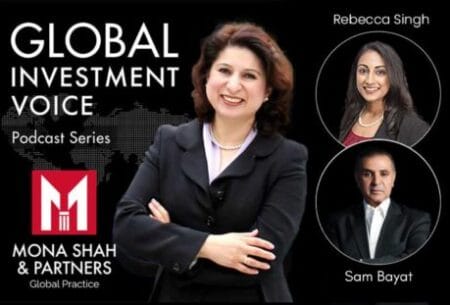
War on Iran | One Weekend That Changed the Case for a Second Citizenship Forever | Episode 234 with Sam Bayat
Recorded on March 2nd 2026
This week’s episode starts off quite unlike one we have experienced before in the 10 years of this podcast series!
We speak again with our guest, Sam Bayat, who joins us from Dubai, a city that, just merely hours ago, was under missile alerts and explosions. Sam talks about his experience of a weekend of regional conflicts, and the city’s poise in the face of a disaster.
But the question, of course, comes up: in today’s world, when does a second passport stop being a luxury and become a necessity?
We talk about the UAE’s golden visa, how the Government of Dubai managed to maintain order and the implications of this situation for investor confidence in the region. How is Sam’s second office in Tehran managing? Which countries are open for Iranian people? Sam stresses the point that if you only have a passport of one country, you’re always at the mercy of things beyond your control.
This is a first-person account of the Gulf’s conflict, and a direct discussion about the implications of passport diversification in 2026.
“My message to clients in general is don’t act out of panic and also don’t wait for everything to resolve by itself. Explore both solid regional residency programs, for example, the UAE Golden Visa, and where possible a second citizenship that is actually accessible to you. And of course, if you do apply for second citizenship, this is not a betrayal of your country of origin but to protect your family until the situation becomes better.”
— Sam Bayat
Sam Bayat
In 1993, Mr. Sam Bayat established a boutique law practice in Dubai to promote Canada as a preferred destination for investment and migration. The firm, initially known as “Canadian Legal Services,” marked the first Canadian law firm in the GCC. In 2007, the firm name was changed to Bayat Legal Services. Today, Bayat Group boasts a global presence. The primary areas of expertise encompass corporate migration, economic citizenship, investments, and tax planning. Mr. Bayat has also served as the former president of the Canadian Bar Association’s International Section in Quebec.
In addition, check out our previous podcasts with Sam Bayat here!
Think you may have missed a podcast? Then check out our recent episodes to catch up!
Transcript
This transcript was produced using AI and subsequently edited for style and clarity. The edits do not alter the substance of the speaker’s remarks
Mona Shah
(0:58) Rebecca, we have never opened an episode quite like this. Sam Bayat, you’re joining us from Dubai, a city that was under a missile attack just hours ago. Sam, before we get into anything else, how are you?
Sam Bayat
(1:14) Well, good evening from Dubai. We’re Monday night here. I’m very well.
It was quite an unusual weekend for Dubai. We are used to seeing regional tension on television, but this time we could feel part of it in real time. There were alerts, there were sound in the skies, and of course, a lot of messages on our phones.
(1:36) But what impressed me the most, honestly, was the people’s behaviour. I went to the mall, I went to the supermarket, and I didn’t see any looting, no panic buying, no fights over basic goods. People were calm and respectful.
(1:52) And that was quite a discipline on how everyone was handling the situation, which reflects something very deep in the UAE, the ability for the UAE nationals, the locals, as we call them, and the expats to coexist and to trust the system even under stress.
Rebecca Singh
(2:12) Yeah, that’s interesting to hear, Sam, because you would think in something where you are under a missile attack, there would be chaotic behaviour, you don’t know where to go, what you’re doing. Tell us, what did you feel when you were on the ground? Did you feel anything?
(2:28) Were people scared? Like you said, it seems like everyone just kind of took it as a normal day.
Sam Bayat
(2:34) Well, look at it. It was not a pleasant experience, but it showed a lot of maturity in this society here.
Mona Shah
(2:42) Sam, I should add that your office isn’t far from the palm where that explosion was, right?
Sam Bayat
(2:51) No, we’re on Sheikh Zayed Road, so my house is actually opposite, next to the World Trade Centre. We have a beautiful swimming pool on the top, on the 30th floor, so you can have a commanding view of everywhere around, it’s almost a 360.
Mona Shah
(3:05) Were you close? How far away were you from the explosion?
Sam Bayat
(3:08) Well, it’s not far, you can see it, but there was not an attack. These are some missiles that are being shot down and some debris fell down. It’s not like there was a deliberate attack, because there was some news that they had hit the Fairmont on the palm, but that was not the case.
Mona Shah
(3:27) And how is your office and your team in Tehran? Have you been able to reach them?
Sam Bayat
(3:34) Yeah, well, we stayed very close with our colleagues and friends in Tehran as much as possible. The mood, of course, is very mixed. On one side, there’s fear, that’s natural when strikes and uncertainty are present, but there’s also emotional fatigue after years of sanctions and economic pressures and political tensions.
(3:53) I would describe it as a complicated rather than a one-dimensional issue, you know, it’s not just one factor. Of course, some people are worried about escalation, others are cautious, you know, so it’s a lot of mixed feelings. You know, the Iranians are sophisticated politically, they feel both hope and concern at the same time.
(4:13) But I guess we have to respect the complexity rather than reducing them to one emotion.
Mona Shah
(4:21) Well, if I could just take it back for a moment, back to the UAE, because we know that the UAE is a very popular destination, not just for tourists, but for people like going there for the Golden Visa. Do you think that an episode like this is actually going to hurt the Golden Visa programme?
Sam Bayat
(4:38) I don’t think so. I think Dubai is going to keep moving. Of course, there was concerns, everybody was checking the news, calling family.
(4:45) But you know, it was funny, the city didn’t freeze. Offices were, banks functioned, flights were adjusted in an orderly way. Of course, the airport is still closed, the airspace.
(4:56) But the business community has a remarkable continuity. You know, meetings moved online, but they happened. The government publicly praised the private sector for its resilience, Minister of Economy, they were always in touch with us.
(5:09) The level of confidence in institutions here should give a very strong signal to the investor that this is a place where even under pressure, the economic engine is expected or keeps running.
Mona Shah
(5:23) That’s a little different from what we’ve been hearing on the news. Rebecca, how was it in the UK? Because I understand there was some panic over there, considering how many Brits are in the UAE.
Rebecca Singh
(5:34) Yeah, yeah. I think it’s the fact that everyone, you know, you hear that everyone’s trying to come out of Dubai. And it’s kind of been a standstill, if I’m not mistaken, Sam, that…
Sam Bayat
(5:43) Well, it is, it is. The airspace is closed. Obviously, the flights are cancelled, you know, so there’s a lot of people.
(5:49) I think there’s a lot of people stranded here because they want to go, there’s a lot of people want to come in. Of course, that’s that because there are missiles going across the Persian Gulf here back and forth. Well, not back and forth, actually, they’re coming out mostly.
(6:02) And there’s the defence system. But locally, sitting on the ground, I did go around, it’s quite calm. And I think what people should, their take should be, it should tell the investor that the UAE takes price management seriously.
(6:18) And they’ve done a fantastic job. When you have an air defence system performing at the highest interception rate possible, and at the same time, you have the minister of communication communicating the continuity of service, it shows that you’re not depending on improvisation, there’s planning, coordination, and a clear chain of command. For investors, that’s critical.
Mona Shah
(6:41) It is. I did read, though, that the Jebel Ali port was targeted. And that’s strategically one of the most important hubs in the area.
Sam Bayat
(6:49) Yeah, but since the rate of interceptions is so high, there was a few missiles that were able to get through. And the damage is minimum, you know?
Rebecca Singh
(7:00) Yeah, I find that interesting, because last night, I was at a lecture, and we were talking about journalism. And one person said that, you know, they didn’t want to go into this because incorrect information, not the right news are coming out. And so, you know, we’re hearing completely something different from what you’re saying, Sam, from what we’re hearing on the news and outlets in that, you know, this is not as chaotic, as I was saying earlier, as we had expected it to have been.
Sam Bayat
(7:26) It is absolutely not chaotic, because I went to our grocery store here, goes usually to Spinneys. And there was no line out, people buying in panic, there’s nothing like that. Zero, zero, zero.
(7:40) You know, there was plenty of food on the shelves. And, you know, it was quite civil.
Mona Shah
(7:46) Yeah, right. We have a storm in New York and the food shelves go off. But let me move on, Sam, and really say, I do believe that this region now, I believe is going to be changed.
(7:59) I believe that the whole issue of second citizenship, wherever, is going to be looked at differently. It’s not so much a luxury anymore as a necessity.
Sam Bayat
(8:08) I absolutely agree with you. If you look at the Golden Visa, how it was designed, the Golden Visa was designed for people to understand that the vault is volatile. And they want a long term anchor in this jurisdiction.
(8:21) They can manage it to think there’s their farewell. After seeing how the UAE handled this situation, how they are handling this situation, the defence performance, the communication, the clear communication, the social cohesion. I think many investors will feel even more comfortable with their residency here.
(8:41) And, of course, I go back to what you said. It’s not just the UAE Golden Visa. It’s the Golden Visas in general.
(8:46) It’s the Golden Passports in general. It’s that overall planning.
Mona Shah
(8:51) I mean, you’re still in touch, you said, with your staff in Tehran.
Sam Bayat
(8:54) Yes.
Mona Shah
(8:55) Are you getting any messages or anything from anyone who’s looking to come out right now? And if they are, as Iranian nationals, where can they go? There’s so many countries are closed to them.
Sam Bayat
(9:06) These products or how we help people, you don’t engage in it in the time of Christ. You can’t get your documents. You can’t come out.
(9:17) So the message you get from Iran, for example, today is this panic. I mean, they’re bombing everywhere. Somebody was telling me they’re actually systematically bombing all the police stations.
Mona Shah
(9:29) Yes. I heard that this morning. Yep.
(9:31) Yes.
Sam Bayat
(9:31) There is active bombing campaign going on. So the reality on the other side is totally different than what’s happening on this side. And we have to look at it from two perspectives.
(9:42) From the perspective of someone living in the UAE with a Golden Visa, I feel it’s a safe place to be. I feel safe. You know, of course, there are some people here in the UAE, they’re panicking and they’ve left the city.
(9:57) I think they exaggerate. But the reality on the other side of the Persian Gulf is totally different. They’re being bombarded by hundreds of missiles and aeroplanes and aircraft and everything.
(10:11) And their reality is different. But they should have plans and they should have, you know, foreseen visas, passports.
Mona Shah
(10:18) But at the same time, I mean, we deal with a lot of Iranians. And I know, of course, you deal so much with them. The Iranian people have wealth, they have education, they can go into so many amazing areas from medicine, you know, plastic surgeons and all the scientists, but to art and all of the cultural side.
(10:37) Is there a brain drain coming out of Iran right now? Do you see that happening?
Sam Bayat
(10:41) Well, when you say now, it means in the last days and the days to come. (10:46) No, but the drain has happened over the years, from the revolution in the late 70s till now, you know, there’s been a tremendous emigration of the Iranian diaspora outside. (10:59) When we moved to Canada in the early 70s, my parents moved to Montreal and I think there were 69 families there living in Montreal.
(11:08) And today I think we are nearly 200,000 and four or 500,000 in Toronto, probably 300,000, 400,000 in Vancouver. (11:16) So it’s not the same thing. (11:18) So obviously, these are wealthy people, these are smart people, educated people.
(11:23) But if we look at now, it’s a different story.
Mona Shah
(11:27) Yeah. (11:27) I mean, look, as you say, after a major crisis like this, you can’t suddenly just jump into second citizenship. (11:34) But a weekend doesn’t create a demand for a second citizenship, but it does crystallise the need.
(11:40) That’s, I do feel, has happened from this weekend. (11:44) Yeah.
Sam Bayat
(11:45) What I think the key lesson is not to rely on a single document for your entire life’s strategy. (11:51) If all your mobility, your banking, your business travel depends on one passport tied to one country, you’re exposed to political risk you can’t control. (12:00) Like today, for my clients, for many clients, the layered approach makes sense.
(12:05) A long-term residency in a stable hub, for example, like the UAE, a golden visa, then you add a layer of citizenship that enhance the mobility, provide some guarantees, you know, and then if things deteriorate at home, like now.
Rebecca Singh
(12:21) I think that works too, Mana, in any country, really. (12:24) I mean, even in the US, you know, you think you have the strongest passport or you have the strongest nation and still people are looking for that second citizenship. (12:34) And I agree with you, Mana, I think this does crystallise it into what are the Iranians going to do in the future?
(12:40) Are they going to plan for that second passport? (12:43) But I think that works anywhere right now.
Mona Shah
(12:46) Right. But Sam, what would you suggest for Iranians who might want to have a second citizenship right now? Where can they go?
Sam Bayat
(12:53) At the moment, Iranians, they have a slight mobility situation where many traditional citizenship by investment programmes either do not accept Iranians or impose severe restrictions on banking access to them. You know, they’re fairly limited. There’s a new programme, that’s Saint-Tome and Principe, a former Portuguese enclave, and they have an excellent programme that do take Iranians.
(13:18) Dominica is taking Iranians in the Caribbean. So those are just too popular, I would say. That will give the Iranian a different identity, which then they can build on that a golden visa, which would be either the UAE residency or maybe even a European golden visa like Portugal, Spain, Greece, Hungary, then that will give them access and more mobility.
Mona Shah
(13:45) You know, it’s just wonderful hearing your calm, confident voice, Sam. You know, we were in a panic when we thought, oh my God, Sam is in Dubai. Oh my God, is he going to be okay?
(13:54) But I do know that people in the region will have this fear and you probably are getting a lot of calls at the moment at your office. What message do you want to get out for people in the region, not just your fellow Iranians, but perhaps people just in the whole MENA area?
Sam Bayat
(14:14) Well, my message to clients in general is don’t act out of panic and also don’t wait for everything to resolve by itself. Explore both solid regional residency programme, for example, the UAE golden visa and where possible a second citizenship that is actually accessible to you. And of course, if you do apply for a second citizenship, this is not a betrayal of your country of origin.
(14:42) It’s a way to protect your family until the situation becomes better where you can go and you can see your talents flourish freely.
Mona Shah
(14:52) That’s a really good point, Sam. That second citizenship isn’t a betrayal of your country.
Sam Bayat
(14:57) Of course it’s not. Look at me. I got a few and I’m still considered an Iranian and by heart I’m an Iranian.
(15:04) But I’d like to also say something else. I think this weekend has reinforced my confidence in the UAE as a place to live and work. I’ve seen how the society and the institutions behave under real pressure and gives me a reinsurance.
(15:21) My own strategy is layered. My family has deep roots in Canada. I base my professional life here in Dubai, mainly in the UAE.
(15:29) And I have always been aware of additional options throughout residency citizenship that works with every day. I’m not about running to another place from one place to another, but I think it’s better to create flexibility in a scenario where you look at your family and your clients and you create choices.
Mona Shah
(15:48) Couldn’t agree more with you, Sam. It’s a difficult moment. It’s a difficult time.
Sam Bayat
(15:53) But, you know, it’s important to sit. But the most important step is to move from the vague anxiety of a concrete plan and wait for the next 30 days. Sit down with someone who understands these issues and make a roadmap, you know, about where you are, your current passport and residency, where your family members are located and where your major assets and businesses are.
(16:20) And then you look at these things and you make a roadmap. And once the picture is clear, you can identify the weak points and discuss specific solutions.
Mona Shah
(16:29) Well, the area has been unstable for so many years. You have people who have lived their lives there. But what we would like to do, Sam, is perhaps revisit this whole topic in a few weeks and see has this made a difference?
(16:43) Has this war made a difference?
Sam Bayat
(16:44) Absolutely. You know, I love to be on your podcast. And, ladies, it’s always a pleasure to speak to you guys.
Rebecca Singh
(16:52) It’s always a pleasure, Sam. And be safe and let us know when you’re able to get back home to Canada.
Sam Bayat
(16:58) Well, I have, I think, two days to get a ticket. Hopefully the airport’s going to open and I should be back with my kids in Montreal.