
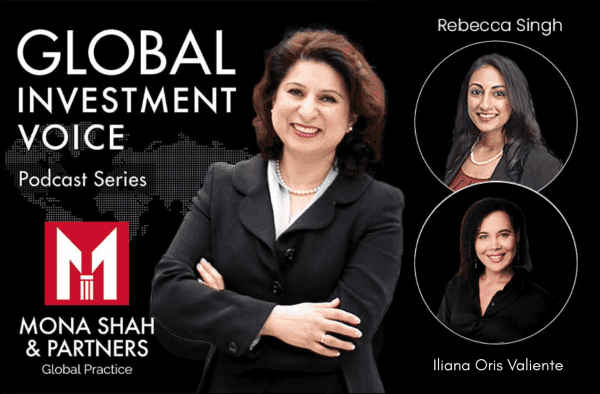
Davos 2026: How a G7 PM Sold Golden Visas Without Knowing It | Episode 231 with Iliana Oris Valiente
What happens when a G7 leader accidentally makes the case for citizenship and residency by investment on the world’s biggest stage?
Canadian Prime Minister Mark Carney made an unexpected declaration, stating the end of the American-led world order at Davos 2026. In doing so, he unknowingly provided the framework to validate what millions of globally mobile individuals have known all along. Multiple citizenships are not divided loyalties, but rather a means of survival, through an insurance policy.
In this explorative episode of Global Investment Voice, host Mona Shah reunites with Iliana Oris Valiente, who was in Davos at the time of Carney’s bombshell speech. Together, they unpack what this means for RCBI programmes across the globe, from the Americas to Europe and beyond.
You’ll discover the reason why Carney’s restructuring of sovereignty highlights second citizenship as a necessity and hear tell-all statistics from Henley & Partners’ 2026 Global Mobility Report, revealing Canada and the UK are dropping in mobility rankings. The conversation explores the evolution of citizenship from a loyalty pledge to a portfolio of strategic rights.
From AI’s disruption of the nature of work to the explosive rise of what Iliana has coined “The Flexible Class,” we connect the dots between geopolitics, investment migration, and your family’s freedom strategy. So, whether you’re considering future-proofing your family’s global options or learning more about Davos, this episode reveals why 2026 may be remembered as when multiple citizenships became a strategic necessity.
The world order has shifted. But the real question is: Has your citizenship strategy kept pace?
“Globally mobile individuals, they’re effectively purchasing insurance policies and the right to live, the right to work in multiple jurisdictions and creating that diversified portfolio effect. And that is exactly the intellectual scaffolding that Carney had laid out in his call and in his pleas.”- Iliana Oris Valiente
Iliana Oris Valiente
Iliana Oris Valiente is the founder of The Flexible Class, a movement designed for global citizens who blend work and travel across multiple home bases. She spends her days as an executive in the corporate world, and she’s also a venture capital investor, and a board member. A published author and frequent speaker featured in the financial times to Bloomberg. The Flexible Class can be found here.
Think you may have missed a podcast? Then check out our recent episodes to catch up!
Transcript
This transcript was produced using AI and subsequently edited for style and clarity. The edits do not alter the substance of the speaker’s remarks
Mona Shah
(0:58) Davos 2026 will be remembered as the moment when a G7 leader accidentally articulated the intellectual case for the entire RCBI industry. And for those who are not sure of the RCBI, I’m talking about the residency and citizenship by investment industry. Back to discuss this with me is someone who just joined us recently and who was actually at Davos 2026, Ileana Ores Valiente.
Welcome back.
Iliana Oris Valiente
Hello, Mona. Thank you so much for having me back.
Mona Shah
Back so soon, right?
Iliana Oris Valiente
I am indeed. There’s lots to report on
Mona Shah
I know. But you did say that you were on your way to Davos. And we did not expect what happened.
I thought you’re going to come back with a lot of boring stuff. I know AI was big on the agenda, but nobody expected Carney’s declaration.
Iliana Oris Valiente
(1:50) No one expected this statement from Canada. I mean, I’ve been attending in Davos for a few years now. And usually Canada is in the picture, but definitely stole the show this year.
Mona Shah
(2:03) I know, I know. And I think it really can be described as Mark Carney speech, meaning it could be described as the most consequential speech in the World Economic Forum history. Because without even mentioning Trump by name, he declared the end or the death, I don’t know if that’s appropriate word of an American led world order.
Iliana Oris Valiente
(2:27) That’s right. A lot of the pundits are essentially saying that Carney said the quiet part out loud, in that the global world order has shifted. And rather than pretending that it hasn’t and sweeping things under the carpet, what is the impact of that?
What is the impact on nation states?
Mona Shah
(2:50) You mean, he basically said what everybody else was thinking? Yeah, it is radical.
(2:56) It’s a total reimagining of the way we have really learned that the world order has been. And I think, and I know we’re going to discuss this in future, but I think we’re going to see a lot more changes. But I know President Trump wasn’t very happy with that.
I mean, he did make, he did respond, and then disinviting Canada from his board of peace, threatening Canada with 100% tariffs.
Iliana Oris Valiente
(3:21) Indeed, indeed. We’ll see how all of that shakes out. Not my place to speculate, but definitely my place to interpret trends and what they might mean.
Mona Shah
(3:31) Well, actually, I mean, talking about interpretation of trends and things, and it takes somebody who’s really understands not only the whole citizenship by investment phenomena. And it is something that when people hear citizenship by investment, residency by investment, they go, well, okay, that’s a certain creed of people. It’s not.
People have been investing, for example, in EB5 for the last 20 something years now. And so I think a speech like this, and the whole idea of the rest of the world actually silently or openly agreeing and nodding, it’s a direct implication, not just for EB5, but the whole RCBI programmes, and really the fundamental right to live in different places, multiple places, I should say.
Iliana Oris Valiente
(4:17) Multiple places, essentially as an insurance policy. So what was interesting about the conversations this year was this topic of sovereignty, which bubbled up in any which way that you can imagine, whether it’s national sovereignty and what it means for a country like Canada, what it means in the AI world. But you can apply that exact same logic to sovereignty at the individual level.
And when you think about the globally mobile individuals, they’re effectively purchasing insurance policies and the right to live, the right to work in multiple jurisdictions and creating that diversified portfolio effect. And that is exactly the intellectual scaffolding that Carney had laid out in his call and in his pleas, essentially, to encourage nation states to rethink sovereignty and what they need.
Mona Shah
(5:13) Well, before we go into that a little bit more, because I know that Davos is where Henley and Partners released their global mobility report of the year, which always raises eyebrows. There was a lot about AI, right?
Iliana Oris Valiente
(5:26) Mm-hmm. There was. I mean, you couldn’t escape the topic of AI on the promenade, especially everything agentic and everything scale deployment.
Mona Shah
(5:35) Wow. Well, I know that AI and the nomadic life have totally changed the way people are thinking. So, I do think, Iliana , we could perhaps save that for another podcast.
Iliana Oris Valiente
(5:46) Oh, we absolutely can. I mean, when I think about AI and the intersection of mobility, there are a couple of aspects we might be able to play with. One is it’s changing the nature of work.
(5:57) And if the nature of work is changing and it increases the likelihood that any individual could be travelling and doing their work remotely, that’s worth exploring. But then there’s also the question of AI applied in the mobility industry itself to streamline a lot of those processes. So, I think that would be worthwhile.
(6:20) And then maybe the third aspect that we could do a deep dive in is once again related to this sovereignty and the new world order conversation and what that means for national economies. And then once again, from an investor standpoint, if you’re looking at which country to hang your hat in, so to speak, how does the country’s investment and adoption of AI feed into your decision making?
Mona Shah
(6:45) Oh, wow, Iliana . We do have a lot for our audiences in the future.
Iliana Oris Valiente
(6:50) I look forward to that one.
Mona Shah
(6:52) But getting back to this, because I always look forward to seeing what the mobility report is from Henley and Partners. And the way it was, it’s always, I think it’s almost always released during Davos Week. At least it has been for the last few years.
But they had some very interesting stats which came up. Who are the risers, the biggest risers, the biggest losers? One of the biggest losers from last year was actually the UK, believe it or not.
And it looks like the next year we are going to see Canada join the same ranks. (7:24) We might.
Iliana Oris Valiente
(7:26) And I mean, to contribute to that, Canada recently announced the ending of their startup visa programme. I mean, to be fair, the wait times for that programme reached almost a decade. And realistically, no investor, no entrepreneur is going to put their entire life on pause while they wait for a determination that’s taking that long.
We haven’t heard quite yet what the new alternative replacement programme might be. The government has hinted at policy initiatives to attract foreign talent. I think that was further reiterated at Davos with the importance of it.
But we haven’t seen that translate into a published policy quite yet.
Mona Shah
(8:10) Right. Right. We actually have delved into some of the issues relating to Canada lately.
And I will be asking your opinion on it at a future date. Because as a Canadian with real inside knowledge, we have a lot of listeners who are very interested. But interestingly, of course, Henley do like to say this.
Another of one of their losers is the U.S., the EP5, because of the hostile environment and unpredictable policy of what’s going on in the U.S. right now. But I will say that although they have said that we are still seeing a phenomenal amount of people wanting to file in the U.S., no matter what President Trump does. ( So I’m not quite sure where Henley and partners are getting their stats from in that.
Iliana Oris Valiente
(8:50) Well, two things can be true. Two things can be true at the same time. So on the one hand, as an investor, the last thing you want is volatility.
When you’re purchasing into a government programme like an EP5 model, you’re purchasing stability. You’re purchasing this idea that your business is subject to rule of law and you can plan and you can anticipate what’s going to happen next year, the year after. But on the flip side, the other thing running through every investor’s mind is how do you diversify?
And having access to the U.S. markets, especially given their AI dominance and potential trajectory on that front, becomes a bit of a necessity. (9:34) So regardless of the amount of volatility and turbulence, I think that’s why you’re experiencing those two realities at the same time.
Mona Shah
(9:43) I totally agree. And going back to Carney for a second, his articulation of sovereignty in a multipolar world, it does go back to people who are wanting a second citizenship or another residency, not for moving purposes, but for insurance purposes or actually business purposes. I, for the first time, have been hearing how people are actively wanting one of the African passports, for example, just so that they can go and do business in certain areas in a more clandestine manner because they feel like they’ll go under the radar with an African passport.
I don’t know whether that is true or not, but it’s an interesting proposition.
Iliana Oris Valiente
The visa-free travel proposition continues to hold true, especially for those who need the quick mobility. And so that’s why I think you’re seeing that.
Mona Shah
(10:35) Yeah. The other winners that Henley spoke of, I believe, were the UAE, which has done phenomenally well by the Brits. Half of Britain has gone out to the UAE.
Then you have the EU, golden visa programmes, Portugal, Greece, Malta, not so much, but Italy for sure.
Iliana Oris Valiente
(10:57) Well, I mean, with Malta being in the headlines of late with the rulings declaring that access to the Schengen zone is limited, that’s put a damper on things, but definitely seeing renewed and continued interest in some of the other locations you mentioned.
Mona Shah
(11:15) Yeah. Let me ask you, was Carney making, I don’t know, was he making a bid for people to come to Canada? Because right now they need entrepreneurs.
They need the tech people from the US to come over.
Iliana Oris Valiente
(11:26) Oh, Canada absolutely needs talent. And in the latest mandate letter he issued to IRCC, so the Immigration and Citizenship Department in Canada, he articulated very bluntly that we need to work on attracting a blend of immigrants to Canada and a specific focus on attracting technology, entrepreneurship, investor type talent, because we do need that additional injection to continue to power the growth of the Canadian economy. Yeah.
Mona Shah
(12:02) I think what was the quote that he said? Canada has what the world wants. Correct.
Then you quote energy, minerals, educated population, fiscal capacity. But when you hit on minerals, now you know why President Trump wants you as the 51st state.
Iliana Oris Valiente
(12:18) Oh, absolutely. We are resource rich, land rich, educated population. So it’s a pretty compelling place to be, despite the fact that for the past couple of years, the value of the Canadian passport has declined in a couple of the indices from a top seven passport down to, I think it was number 14 or number 18 in a couple of years.
Yeah.
Mona Shah
(12:46) I also read that there was a philosophical shift, again, articulated by Mark Carney. For example, citizenship previously indicated you had a singular loyalty to one nation state. When you become a citizen of the U.S., for example, you do your Pledge of Allegiance to the flag. When you become a citizen of the United Kingdom, you do your allegiance to the queen. Well, was the queen, now the king. Whereas now the emerging view is more that citizenship is just your portfolio of rights and options.
Very different. It is.
Iliana Oris Valiente
(13:18) And I mean, it’s a philosophy that I’ve subscribed to for many years. My friends have joked that, Ileana, you have been a global citizen quite literally since you were born. And I deeply, deeply hold that view that this idea of citizenship as we know it is a very artificial construct to begin with.
Borders are manmade things and borders get redrawn. If you go back and you look at the history books over a 50, 100, 150, 200 year horizon, think about the number of countries that have had their borders redrawn. And so therefore, it’s a bit of a simplification to assume that citizenship equals by default loyalty to just one nation state.
And increasingly, we’re seeing that decoupling where people are saying, well, I might have my business registered in one jurisdiction. I might have my personal tax residency in a different jurisdiction. And I might spend a portion of the year living in a third jurisdiction or fourth jurisdiction that is more aligned to personal lifestyle goals and objectives.
And so the ability to fragment one’s life and to create that portfolio, we’ve seen it for years as an emerging trend. And what Carney said essentially just provided a new way of thinking about it at a larger scale.
Mona Shah
(14:43) Oh, so you’re saying the multiple citizenships being traditionally seen as divided loyalties is now shifted over to risk management and basically global mobility?
Iliana Oris Valiente
(14:54) Absolutely. Global mobility is the rational response to uncertainty. If you think back to COVID and how many people found themselves stranded when a country border shut down, imagine that scenario playing out again, but not due to a pandemic.
And with the current state of affairs in the world, it is not a stretch to say that you may have border shutdowns and closures and restrictions that come nearly out of left field. And so how might you prepare for that? And so those who have the ability to are setting themselves up by having this portfolio approach.
Mona Shah
(15:35) Oh, wow. It’s just all so incredibly interesting. Was there anything else of significance?
(15:41) I’m saying what else? I’m sure this really did take up most of the stage, but was there anything else of significance which came out of Davos of 2026?
Iliana Oris Valiente
(15:50) I think the big themes were definitely the shifting world order and everything AI. I’m hearing the conversations from artificial general intelligence and when is it coming to the implications on the workforce, to the rise of robotics and physical AI. I mean, robots at dinner parties were seen.
Mona Shah
(16:16) I have one question though. I mean, most of the time when you see these statistics that Henley’s put out or Artin put out, they do really sort of focus on a millionaire search and a and as we’ve discussed, nomadic life, the way we are seeing it now, isn’t there just for millionaires. It’s for many other categories.
It’s no longer that niche. Did you see that type of trend emerge?
Iliana Oris Valiente
(16:45) That type of a trend is definitely there. It wasn’t covered in the Davos discussions, but when you look at countries and the way that they grow their economies, you can tax your existing citizens. You can borrow debt that then your future generations are repaying.
You have internal growth that powers your own economy, or you can start tapping into the globally mobile demographic that is coming into your country and creating an entire new revenue stream for a nation state. And countries are realising that, wait a second, why aren’t we rolling out the red carpet to attract that population? And it does not have to be limited to the ultra-high net worth.
(17:39) It also extends to the AI researchers and the developers and other professionals who’ve done really well in increasingly lucrative fields that are coming into a country, spending time there, spending money through the various programmes and application fees, through the real estate leasing and purchasing that they’re doing, through all of the ancillary spending that they’re doing in that region. So suddenly you’re seeing nations rolling out marketing campaigns effectively to attract a broader swath of that travelling population. So it’s definitely worth paying attention to.
(18:24) And increasingly, because of accessible air travel, and because of the proliferation of these remote work and digital nomad type visa programmes, you’re seeing a broader class of people who are saying, wait a second, I want to be more geographically mobile. Hence the statistics that show 40 plus million people are already identifying with the digital nomad label. Another 80 million people are in the aspiring nomads category.
And that is orders of magnitude higher volumes than traditionally what the residency and citizenship by investment programmes have catered to or have thought of within their demographic. That’s why I’ve been calling this broader cohort of people, the flexible class, because it really is far broader.
Mona Shah
(19:17) And Henley projects there to be an unprecedented wave in 2026. So let’s see. Iliana, thank you so much for coming back on Global Investment Voice.
And we look forward to discussing AI and other great topics with you again in the future.
Iliana Oris Valiente
(19:33) Wonderful. Really looking forward to coming back.