
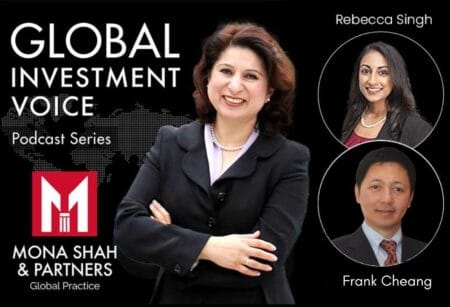
From Tokyo to the Mediterranean: Building Wealth and Mobility Across Two Continents | Episode 238
Wondering where your next global mobility move could take you?
Mona sits down with Frank Cheang of Elysium 8 Holdings, a firm describing itself as more than a brokerage but a strategic gateway. They discuss three countries: Japan, Portugal, and Greece, including where investors are going wrong.
Our discussion begins with Japanese real estate, and the numbers alone are worth listening to. Foreign investors are claiming mortgage rates of 3-5%, whilst citizens can borrow at 1% with 100% LTV. Almost 250 episodes into Global Investment Voice, and we are only just landing in Japan… We should have booked this trip sooner.
From there, we move on to the better-known programs along the Mediterranean, with benefits that are harder to put a price on. Freedom to move, work, and outstanding education options. Portugal’s Golden Visa has raised over six billion euros and offers the fastest route to citizenship in Europe, five years. Whilst Greece takes seven years, they have zero minimum stay requirements, excellent for global investors.
Japan, Portugal, and Greece all have something different to offer, whether you’re a seasoned investor diversifying or a family weighing up your long-term options. This episode brings all three together to make your choice easier.
Frank Cheang
Frank Cheang of Elysium 8 Holdings is a hospitality investment specialist based in Hyogo, Japan, focused on boutique and luxury hotel acquisitions, as well as cross-border real asset strategies. He works with international investors and globally mobile families to source and structure opportunities that align with residency and Golden Visa programs, particularly in Europe, including Portugal and Greece. Collaborating with legal and advisory partners, Frank helps clients navigate both the investment and immigration sides of a transaction, supporting decisions around jurisdiction, capital deployment, and long-term positioning. His work sits at the intersection of hospitality, cross-border investment, and global mobility, where property is increasingly being used not just as an asset class, but as a pathway to greater flexibility, security, and generational planning.
Visit Elysium 8 Holdings here
Think you may have missed a podcast? Then check out our recent episodes to catch up!
Transcript
This transcript was produced using AI and subsequently edited for style and clarity. The edits do not alter the substance of the speaker’s remarks
Mona Shah
(0:59) Today on Global Investment Voice, we are crossing three countries and two continents in under 20 minutes. Today, we have with us Frank Chang and of Elysium 8 Holdings. The firm described itself as, not as a brokerage, but as a strategic gateway for international investors.
(1:19) We are covering Japan real estate, which I don’t believe we’ve covered before. And then we are going to go deeper into the Greek and Portuguese golden visa programmes. What they actually deliver, where investors are going wrong and how families are using them to plan for the long-term.
(1:37) Frank, welcome to the show.
Frank Cheang
(1:39) Good morning, Mona. Thank you very much for your invitation. It’s a pleasure to be here today.
Mona Shah
(1:45) So, as I just stated, Frank, you describe yourself and I picked it up from one of your brochures. We’re not a brokerage, but a strategic gateway. What does that mean?
Frank Cheang
(1:56) Yes, we don’t want to be categorised as a broker, as most people are. What we like to do is that we like to offer an overall approach and outcome for investors or families. So that’s why we position ourselves as a strategic gateway, rather than a broker.
Mona Shah
(2:17) Interesting. And really, what has drawn you to the global mobility space? Because everybody has a story here.
Frank Cheang
(2:26) Yes, absolutely. Well, it kind of started back in Canada when I was there, when I was networking in the Portuguese community. And that’s where it started.
(2:37) And then gradually expanding into the global scene. And then now, now I’m based in Japan.
Mona Shah
(2:44) Wow, yes.
Frank Cheang
(2:45) I’m born Canadian, I just wanted to add that, my background.
Mona Shah
(2:50) Yeah, truly, truly, truly global, Frank. But you know, we were just, I was just discussing with Rebecca earlier, we have 250 plus episodes, and I don’t believe we’ve, thank you. I don’t believe we’ve ever really discussed Japanese real estate.
(3:06) Now, I know we have a whole programme dedicated to this later but just tell us a little bit about this right now. You know, right now, Frank, with the war in the Middle East, I know people are assessing the world a little differently. Is Japan an actual destination for anyone sitting in the US, the UK, or even someone in the Middle East?
Frank Cheang
(3:27) Absolutely. I think Japan offers a rare combination. It’s a developed, stable market with relatively low entry prices, if we’re talking about real estate, and consistent rental demand.
(3:40) First, there’s long-term low interest rates in Japan, typically around one to two percent for local financing.
Mona Shah
(3:48) Wait, wait, wait, wait, wait, wait.
Frank Cheang
(3:50) Exactly, yes.
Mona Shah
(3:50) Are you saying one to 2% for, is that like for a mortgage?
Frank Cheang
(3:55) Yes, exactly.
(4:01) Well, let me shock you some more.13 years ago, when I purchased my personal home, interest rates were under 1%, was basically 0.9%. So essentially, its free money, basically.
Mona Shah
(4:16) Yes.
Frank Cheang
(4:16) And let me add something else that’s shocking. I was also shocked when I first received the confirmation of the mortgage on the home. The bank that we dealt with, they approved a 100% LTV mortgage.
(4:30) Now, where have you heard of that before?
Mona Shah
(4:32) I haven’t. Oh my goodness.
Frank Cheang
(4:33) I’m proof of it. 100% LTV loan.
Mona Shah
(4:38) Yeah, Frank, we, well, as I said, we are going to discuss this in detail later but let me just ask you one last question about this, because I’m seriously thinking of packing my bags and moving to Japan.
Speaker 4
(4:50) Well, you’re welcome. I’ll meet you at the airport
Mona Shah
What are the market entry realities? Seriously.
(4:58) I mean, is it a difficult market for foreign buyers to come in? You obviously are saying, giving us these low interest rates, but that’s because you live in Japan. If somebody is just emigrating, I mean, what, is there a complex legal structure?
(5:11) How are the ownership rules? What about language barriers?
Frank Cheang
(5:15) Right, of course. Well, those types of interest rates, first, they’re there for residents in Japan. And because I have permanent residency, so that makes a difference.
(5:24) For foreigners, if they qualify for mortgages, loans here, that will go up to probably 3% to 4% interest. But still, it’s comparable.
Mona Shah
(5:36) That is still, 3% to 4% is still amazing. Wow.
Frank Cheang
(5:40) So the important thing for foreign investors to know here in Japan is that foreigners can own property freehold. And well, of course, it needs to be very structured with the local team in Japan. Because like I said, everything’s in Japanese.
(5:58) You need a coordinated local network of real estate agents, legal professionals, and property managers.
Mona Shah
(6:05) Yeah, of course.
Frank Cheang
(6:05) So basically, our role is to bridge that gap and ensure the investor understands what they’re buying, how ownership is structured, and how the asset will be managed after the acquisition.
Mona Shah
(6:17) Well, all I can say is that it really, Japan makes a compelling case for yield and portfolio diversification for all those who are listening out there. And it’s something that we, it’s a country that we will want to come back to. And I’m so surprised that we haven’t discussed this before.
(6:34) But let us shift to Europe, Frank, where the conversation really is less about the income return. It’s more about something, I would say, equally valuable for a certain type of investor, residency rights, long-term mobility, the ability to move all around Europe. And Elysium 8 really focusses on Portugal and Greece.
Frank Cheang
(6:55) Yes, well, let me begin with Portugal. As you may know, Portugal’s Golden Visa was introduced back in 2012.
Mona Shah
(7:02) Yeah, some time ago.
Frank Cheang
(7:03) Yeah, some time ago, with a couple of law changes. But the programme has attracted over 10,000 main applicants historically.
(7:12) So yes, quite a large number.
Mona Shah
(7:14) So do they have a country cap the way we do have in the US?
Frank Cheang
(7:18) Well, the best way I can answer that, Mona, is based on the last two Golden Visa law changes. And that’s basically how the government kind of wanted to have a control on the foreign investors coming in and purchasing real estate directly and affecting local property prices. Because locals, you know, they started, were unable to afford the properties because of all the inflated prices, just like everywhere else.
Mona Shah
(7:43) Yeah, there was all around by the Algarves. I remember it happening when it first happened, and it was very unpopular with the locals. But the programme, I understand, Frank, has brought in more than 6 billion euros into the country.
(7:54) That’s correct.
Frank Cheang
(7:55) Yes. Over 6 billion, yes.
Mona Shah
(7:57) It’s not likely to go anywhere. I think the, I know it’s changed, and we’ll get into that, but it’s not likely to leave at this point.
Frank Cheang
(8:04) No, I don’t think so. Although there are, legislation is discussing some changes in the law, current law, because right now, as you know, it’s still only five years for investors to apply for citizenship in Portugal.
(8:18) Which is one of the shortest programmes in Europe.
Mona Shah
(8:21) That’s right. Most of the European citizenship programmes are much longer, but what is the minimum stay requirement for Portugal?
Frank Cheang
(8:28) For Portugal, it’s an average of seven days a year, per year. So, it’s kind of like a vacation, you know, you take a vacation somewhere, you know, well, you have to take it in Portugal, I guess.
Mona Shah
(8:38) And if we jump to Greece for a second, what’s the minimum stay in Greece?
Frank Cheang
(8:42) Well, in Greece, there is no minimum stay requirement, which is attractive for global investors.
Mona Shah
(8:47) Yes. I see that Greece, although Portugal is popular, I see that Greece is really catching up in popularity. And how long does it take to get citizenship and a permanent stay in Greece?
Frank Cheang
(8:58) In Greece, it’s, okay, so first, if I can say, first, Greece, you can directly purchase real estate in Greece to qualify for the Golden Visa. And it’s not a direct path to citizenship. However, there’s a naturalisation process which takes seven years.
(9:15) You have to wait two more years compared to Portugal.
Mona Shah
(9:18) Right. Do you have to have a language requirement in either country?
Frank Cheang
(9:21) For the citizenship in Portugal, yes, that will be required, like a certain level of Portuguese is required to apply for the citizenship. And Greece is also required, from what I understand.
Mona Shah
(9:34) So where does Elysium 8 come in? I mean, do you source property? Do you help the investor?
(9:39) What do you guys do?
Frank Cheang
(9:41) Yes, exactly. We coordinate, well, if it’s the Greece programme, then we help source the property, depending on what the investor is interested in, because there’s three tiers in Greece, if it’s real estate.
Mona Shah
(9:55) Right.
Frank Cheang
(9:55) The higher prime areas range from 400,000 euros to 800,000 euros. And some of the regional zones still have the low price point entry of 250,000 euros. But those are the commercial buildings that are converted into residential units.
Mona Shah
(10:14) Yeah, I also saw, the last time I was in Greece, I saw a whole bunch of developers creating student apartments, these little boxes. And those all run at the 250.
(10:24) But a lot of our listeners really want to go to Greece and Portugal. They really are looking at purchasing property there, Frank. And there are a number of common investor mistakes.
(10:34) And I think you guys are very good at pulling out these.
Frank Cheang
(10:38) Yes, that’s right. So, the biggest mistake is treating these programmes as purely transactional.
(10:51) Well, yes, true. However, you asked what is our role, right? So basically, we have to also, well, we’re not looking at a one-off purchase with the investor.
(11:00) We’re here to provide ongoing support with the family because it’s very important for a family to migrate. It’s one of the biggest decisions in their lives. So it’s very important for us to be there on the ground to help these families integrate and just provide ongoing support.
(11:17) Because for example, in Portugal, it’s the five-year period for the Golden Visa. So, there are a lot of things that happen within that five-year period. So to guide and assist the family for each stage.
Mona Shah
(11:30) What about if we have a person who just wants the, just the experience of being able to go, maybe they don’t want to live there permanently, they want to stay and live in the US, but they just want another escape route. Do you help them with that?
Frank Cheang
(11:43) Yes, absolutely. So that would be basically the residency route. So then we have to see what exactly is the objective.
(11:51) And if they’re just looking at maybe a real estate investment and would like some yield on it annually, then we would suggest, for example, the Greece programme.
Mona Shah
(12:00) Right, right, right.
Frank Cheang
(12:00) Or if they prefer regulated investment funds, then we could suggest Portugal. It really depends on what they’re interested in.
Mona Shah
(12:08) You know, so many people come into this space because it seems initially very easy to come into and find an investor and well, make quick money, so to speak. But there are some important dimensions which you do need experience for, Frank. I’m sure you can speak to this.
(12:27) A lot of people perhaps purchase property in the wrong places. They choose price, probably location based on price rather than long-term utility. They underestimate document preparation times.
(12:39) What else? What are the mistakes? Could you see?
Frank Cheang
(12:42) Well, if I can just kind of summarise the different programmes or the jurisdictions, like, for example, if I can just touch on Japan just again for a quick moment, is Japan provides like a stable income for-
Mona Shah
(12:55) We don’t mind you going back to Japan.
Frank Cheang
(12:57) So Japan will provide stable income. So, you know, as I mentioned, it’s a cashflow play. You know, you would invest in some yield properties.
(13:07) Greece offers accessible residency with flexibility because there is no stay requirement, but it is a seven-year path to citizenship. You know, Portugal still provides a structured path to citizenship. So that is very clear, but unfortunately, it’s not directly investing in real estate anymore, but still.
(13:26) So it really depends on what the family is interested in. You know, is it income, is it mobility or long-term optionality, you know, across the region.
Mona Shah
(13:36) What about taxes?
Frank Cheang
(13:38) Yes. So, each programme and jurisdiction has favourable tax benefits. I like those words.
Mona Shah
(13:46) I love the word tax and benefits in the same sentence.
Frank Cheang
(13:49) Yes, yes, yes. So yeah, for example, in Portugal, there’s a 10-year period where foreign investors do not have to pay local taxes. So it depends on the amount of residency that they spend in Portugal.
(14:03) Actually, Mauritius is actually another reason why it is becoming a popular destination because of the favourable tax planning and tax benefits there.
Mona Shah
(14:11) Okay, well, Mauritius is on our agenda as well, but I believe your partner Nick covers Mauritius, right?
Frank Cheang
(14:17) Yes, it’s best for him to do the next episode on Mauritius. He’s much more familiar than I am.
Mona Shah
(14:24) Yeah, that’s definitely another one on our agenda. But let me ask you, do either programme require relocation or can you, is somebody who’s listening can say, look, I’m really interested, but I don’t want to completely relocate. Can I still join these programmes?
Frank Cheang
(14:41) Absolutely, absolutely. So, the number of days that the investor spends in each country, that will determine their tax status. So, for example, it’s usually the 183-day or six-month period, right?
(14:56) So generally in most countries, if you stay six months or more, then you become classified as a resident. So, you’ll have to pay local taxes. So as long as the investors do not stay more than six months or 183 days, then that would be favourable for them.
(15:10) And of course, that is doable.
Mona Shah
(15:13) Two more quick questions. Education access. Do either of these residency programme open access to European universities’ public education for children?
Frank Cheang
(15:23) Yes, absolutely. When you receive your residency card, that allows your children, the investors’ children, to access any university in Europe that allows you to go in the Schengen area. We like to use the word gateway, so it is a gateway to Europe.
Mona Shah
(15:38) So Frank, gateway it is, but with the pace of change right now, with all that is going on in the world, are you seeing a general shift in global mobility, a speed of people coming in, maybe enquiries?
Frank Cheang
(15:53) Yes, absolutely. Sadly, the conflict in the Middle East has created this for us, I mean, you know, in a good way, of course. Helping families in need and just trying to provide our services to help the family strategy to find, to satisfy their needs.
(16:12) Investment migration is not an easy decision for any family to make. It requires a lot of decision-making and long-term planning. And this is what our role is basically, Elysium 8, is to assist these families in their planning, being patient and understand what their needs are and coordinate with the local teams on the ground.
(16:34) We provide the ongoing support with all the families during the visa periods.
Mona Shah
(16:41) Oh, well, I think that is so important, Frank. And I’m sure we’re going to hear from you again a lot more in the future, because with this change in global mobility and the complexities that we are seeing in the world, Japan, Greece, Portugal, how they all fit together and Mauritius as part of a complete wealth and mobility strategy is going to be a question that I’m sure is going to come up again and again. Frank, thank you so much for coming on the show today.
Frank Cheang
(17:09) Thank you very much, Mona.