
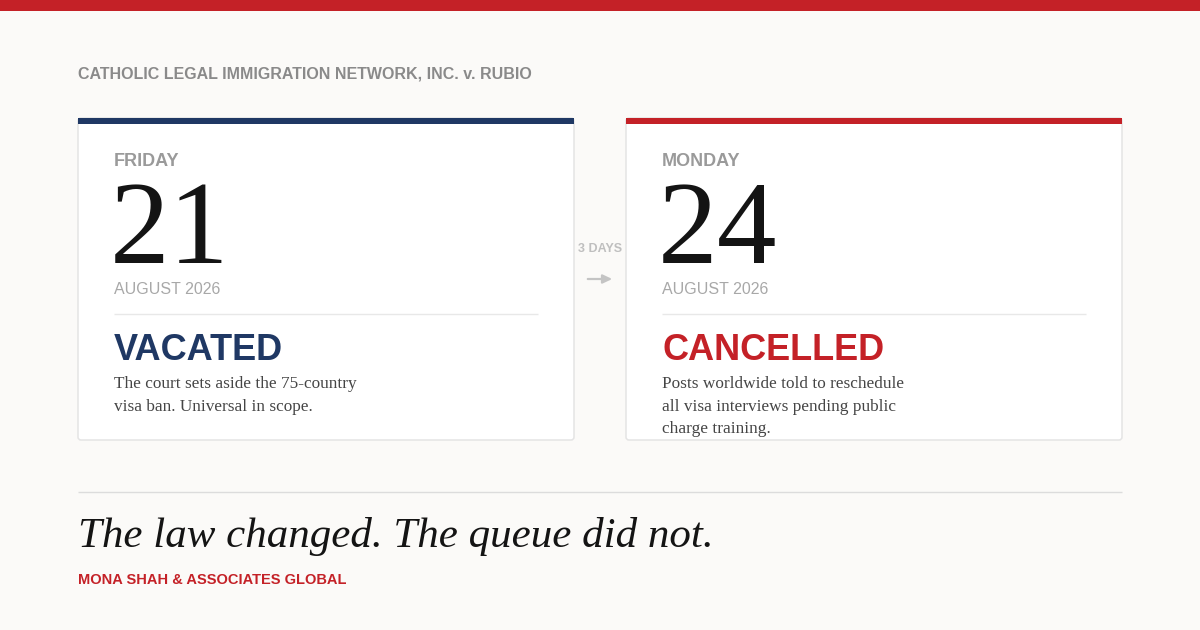
A federal court struck down the 75-country immigrant visa ban. Three days later the State Department cancelled visa interviews worldwide.
What the ruling actually gives EB-5 clients, and what it does not.
An analysis of Catholic Legal Immigration Network, Inc. v. Rubio and its consequences for EB-5 consular processing, INA 221(g) refusals, public charge adjudication, and adjustment of status.
Mona Shah, Esq.
August 2026 | Mona Shah & Partners Global
The first court to hold the 75-country immigrant visa ban unlawful did so for an EB-5 investor. It happened three weeks before the ruling that made the front pages, and almost nobody in this industry noticed.
On July 31, 2026, Judge Amit Mehta of the District Court for the District of Columbia decided De Moura Gomes v. Rubio.1 The plaintiff, Newton De Moura Gomes, was a Brazilian entrepreneur who had invested US$500,000 in a qualifying Arizona hotel project through EB-5 in December 2018. His petition was approved. He was in consular processing in Brazil with his wife and two daughters as derivatives, application filed and interview scheduled, when the pause took effect. In the six years between his investment and his interview he had been diagnosed with advanced, incurable cancer.
The urgency argument was structural, and it is one only EB-5 practitioners will recognize immediately. His family argued that if he died before visa issuance, their derivative eligibility could disappear with him. A program that takes six years to deliver a visa had made mortality a procedural risk. The court ordered the State Department to adjudicate the application. The relief ran to him and his family, and to nobody else.
Counsel was Edward Ramos of Kurzban Kurzban Tetzeli and Pratt P.A., who described the policy as blatantly unlawful and fundamentally unfair, and said the firm was pleased the court had recognized that the State Department cannot dispense with individualized assessment. Note that the first successful challenge to a policy affecting the entire EB-5 consular pipeline was brought by a federal immigration litigation firm, not by the EB-5 industry.
Three weeks later, on August 21, 2026, Judge Jeannette Vargas of the Southern District of New York vacated the policy outright in Catholic Legal Immigration Network, Inc. v. Rubio.2 Sixty-one pages. Universal in scope. Every firm in this space has now published a summary.
This piece is about what the ruling gives our clients in practice, which is less than the headlines suggest, and about how little the government lost. The other half of the story, what the ban did to the EB-5 visa numbers while it ran and who collected, is dealt with in a companion article, “Three Percent”.
1. A Policy That Was Never Finished
The Policy was a State Department announcement of January 14, 2026 and a cable transmitted the same day by Secretary Rubio, effective January 21, ordering consular officers to refuse immigrant visas under INA section 221(g) to nationals of 75 countries who had not already been refused on another ground. Its effect, in the court’s description, was a categorical ban on immigrant visa issuance to nationals of nearly forty percent of the world’s countries.
Read the cable’s own words on why. Officers were to refuse under 221(g) while the Department developed additional screening and vetting tools, policies and operations to identify applicants likely to become a public charge. The refusal was expressly a placeholder, pending machinery said to be under construction.
More than six months later, that machinery did not exist. As Greenberg Traurig noted the day the ruling came down, the Department had introduced no new public charge vetting tools, policies or operations for immigrant visa applicants. The temporary measure was the measure.
There is a sharper version of the point. The Associated Press obtained a copy of the cable, and reports that it stated several times that an applicant must prove they will not apply for public benefits while in the United States, and that officers who suspected an applicant might do so should require them to complete a form establishing their financial bona fides.3 The cable therefore already contained a working individualized public charge mechanism: a burden placed on the applicant, and a documentary instrument for discharging it. The nationality bar was bolted on top of it. The Department was not waiting for a tool. It had one, and refused eligible applicants regardless.
None of this is part of the holding. It is, however, the most useful material in the public record for anyone assessing what the policy was actually for.
2. What the Court Held, and How Little It Cost the Government
Plaintiffs prevailed on Counts One and Seven. The Policy was held contrary to law and in excess of statutory authority:
- 8 U.S.C. section 1152(a)(1)(A), the anti-discrimination provision.
- 8 U.S.C. section 1201(g) with 22 C.F.R. section 40.6, which permits refusal only on a ground specifically set out in law.
- 8 U.S.C. section 1104(a), which expressly divests the Secretary of State of authority over consular grants and refusals.
Trump v. Hawaii was distinguished on the entry-versus-issuance line the Supreme Court itself drew.4 Consular nonreviewability was no bar, the court following Pietersen v. Department of State.5
The opinion is not gentle. The court opened its analysis by remarking that in many ways this is not a challenging case. It described the government’s reliance on section 1201(g) as an exercise in Orwellian logic, its defense of consular discretion as perhaps even more disingenuous, and the Policy itself as a blatant repudiation of the statutory scheme that could not withstand even the most cursory scrutiny. On the argument that the Policy produced no legal consequences because it operated through individual officers, the court replied that the government might as well argue that dropping a rock onto a highway has no consequences because gravity is what sends it into the cars below.
The Policy is thus patently unlawful and must be vacated under the APA.
Catholic Legal Immigration Network, Inc. v. Rubio, ECF No. 83 at 18
Now count what the government kept.
It won on notice and comment. It defeated the section 1182(a)(4) theory outright, so the public charge framework stands. The November 2025 State Department rules were never in issue, because plaintiffs took them out of their own motion, and both travel ban proclamations went unchallenged. And the vacatur reaches only refusals based solely on the Policy, sparing every refusal an officer grounded in section 1182(a) or any other provision of law.
The structural point is the one to hold on to. The 75-country cable was, on the Department’s own account, issued in accordance with a broader November 2025 order tightening the public charge rules. The court struck down the child and left the parent standing, because the plaintiffs did not put the parent in issue. Every operational capability the Department needs to reach the same applicants one at a time survives this judgment intact.
A policy the court called patently unlawful ran for seven months, produced no new vetting apparatus, and was struck down forty-one days before the fiscal year ended, leaving the government in possession of every enforcement instrument it actually wanted. That is not a rout. It is a tactical retreat onto better ground.
The Department’s own response was consistent with that reading. The day after the ruling it said the administration is protecting the American people by upholding the highest standards of screening and vetting of visa applicants, and declined to comment on pending litigation. Not a defeat, in that telling. An ongoing matter.
3. Why an $800,000 Investor Was Caught
This has puzzled the industry since January. Investment Migration Insider put it plainly in June, noting that though an EB-5 investor making a US$800,000 investment seems at little risk of abusing welfare systems in the United States, the policy made no exceptions.
The administrative record explains it, and so did the Department at the time. The court records that the 75 countries were selected using Council of Economic Advisers statistics calculating the percentage of immigrant households receiving some form of public assistance by country of origin, and that every nation exceeding thirty percent was covered, with exceptions for certain countries on foreign policy grounds.6 The Department said publicly, relying on the same Council data, that more than thirty percent of households with immigrants from these countries received some form of public assistance. This was not a rationale that emerged in litigation. It was the announced basis from the start.
So the instrument was a household-level welfare-participation average applied to a nationality, with a diplomatic override bolted on for countries the Department preferred not to offend. It contained no mechanism capable of recognizing an individual applicant’s assets because it never looked at individuals at all, and it was not applied uniformly even to the data it relied on. An EB-5 carve-out was never coming, because the design had no place to put one.
4. The Fourth Bucket
The refusal record determines everything. The cable created three paths: a 221(g) with no other ineligibility identified, vacated and remanded; an individualized 212(a)(4) public charge finding, not vacated; and an ordinary documentary 221(g) for a missing police certificate or deficient I-864, unrelated to the Policy and not vacated.
There is a trap in the cable on top of that. Officers were told that where an applicant overcame a 212(a)(4) refusal with additional evidence, they should then refuse under 221(g). A file can therefore show a 212(a)(4) entry followed by a 221(g). Whether that reads as based solely on the Policy will be contested, and the Department will not read it generously.
And there is a fourth group, which in EB-5 may be the largest of all. It consists of applicants who were never interviewed. They hold no refusal, so there is nothing for a court to set aside, and they are not in the vacated class at all.
A file on my desk illustrates the problem. A Pakistani-chargeable I5 applicant with a late-2019 priority date, documentarily qualified and referred by the National Visa Center to a Gulf post in mid-2025. In December 2025 the post moved interview scheduling to an online portal. In early January 2026 the applicant opened a support case because no scheduling option appeared. The contractor’s answer, given a fortnight before the pause even took effect, was that EB-5 interview slots had not yet been released and that availability is updated periodically.
A visa number was available to him for the entire fiscal year. It went unused.
Note the chronology. He was frozen before the policy everyone is writing about applied to him. Pakistan is Rest of World in EB-5 Unreserved, so his priority date was current throughout. A visa number was available to him for the entire fiscal year. It went unused.
The vacatur does nothing for him. His remedy is unreasonable delay under 5 U.S.C. section 706(1), for which this opinion’s reasoning on consular nonreviewability is genuinely useful, and not the vacatur at all.
Which is the point I would press hardest. The ruling removes a legal barrier. It does not create consular interview capacity. If posts do not release EB-5 appointment slots, the law will have changed and nothing else will have.
5. The Remand Has Nowhere to Go
Judgment was entered on Friday, August 21, 2026. On Monday, August 24 the State Department instructed embassies and consulates worldwide that they must reschedule all visa interviews until consular officers had completed training on the public charge policy, the sessions to run that week.7 Appointments were cancelled worldwide on August 24 and 25. Applicants received notices telling them their interview could not be accommodated until after September 1, 2026.
Asked about the worldwide pause, the Department said through an official that it had launched a global training initiative at all embassies and consulates in early August, and that visa appointments would be adjusted to accommodate it. It did not say when applicants would be given rescheduled dates.
I would not read too much into the sequence. Global consular training is not organized over a weekend, and the Department says the initiative began in early August, which is before either judgment. The point is not that the Department retaliated. The point is that it did not pause, reconsider, or accelerate anything, and that a court order commanding individualized adjudication landed in an inbox already scheduled to stop conducting them.
Read that alongside the judgment. The training is on the public charge framework: the instrument that survived this litigation, that plaintiffs carved out of their own motion, and that the court expressly declined to disturb when it rejected the section 1182(a)(4) count. While the Southern District of New York was vacating the categorical policy, the Department was training every consular officer in the world to apply the individualized one.
On Friday the court restored the right to an adjudication. On Monday the adjudications stopped.
This is also not the first time. A comparable rescheduling wave in December 2025 produced a bottleneck whose backlog has still not cleared. That is precisely the month in which the Gulf post in my file moved to online scheduling and the EB-5 slots stopped appearing. What looked from the applicant’s side like a portal malfunction was the leading edge of the same operational pattern, and it began a month before the nationality ban and has now resumed days after the ban was struck down.
The court set no deadline for the Department to cable posts, reopen the vacated refusals, or reschedule anybody. For clients in the vacated class, the practical position is that they have won a remand into a system that is not currently conducting interviews, on a timetable nobody has published.
6. Where EB-5 Clients Are Strongest, and Why That Is Uncomfortable
The realistic next move is not to reissue the same policy. It is individualized public charge refusals under the November 2025 rules this opinion leaves standing, or a section 212(f) proclamation restricting entry rather than issuance, which Trump v. Hawaii likely permits. On remand, members of the vacated class face a public charge assessment under a tightening framework, with the Department of Homeland Security’s July 2026 final rule taking effect on September 15, 2026, rescinding the 2022 regulations at 8 C.F.R. sections 212.20 to 212.23 and revising the public charge bond provisions at 8 C.F.R. section 103.6(c).
There is a further piece the EB-5 industry has not connected, and it may matter more than the remand. The Associated Press reports that a separate notice went to all embassies and consulates instructing that nonimmigrant visa applicants should also be fully vetted and screened for the possibility that they might seek public benefits in the United States. Consider what that does to concurrent filing. An investor filing I-526E and I-485 together must first be inside the United States, which for most means first obtaining a nonimmigrant visa. Adjustment was the shelter from the ban all year, because AOS filers were never covered by it. If public charge screening now sits at the nonimmigrant stage, that shelter has acquired a checkpoint at its entrance, and that checkpoint opened before the one at 8 C.F.R. section 212.20 closes on September 15.
An applicant who has documented the lawful source of US$800,000 and placed it at risk in a job-creating enterprise is the easiest person in the world to clear on the statutory factors at INA section 212(a)(4)(B). EB-5 investors are, on this narrow question, the best-positioned members of the entire vacated class.
It is worth being honest about what that means. Anna Gallagher, CLINIC’s executive director, said on the day of the ruling that at its heart the case is about keeping families together. The named plaintiffs were six United States citizens whose relatives in Ghana, Ethiopia, Jamaica and Guatemala had been refused, and five Colombian professionals with employment-based petitions. A judgment premised on the illegality of sorting applicants by nationality will now deliver its most reliable benefit to the applicants who can most comfortably satisfy a wealth-adjacent test. Our clients will clear the remand more easily than the plaintiffs who won it for them. That is a real practice point and it belongs in your advice. It is not a reason to be pleased.
7. What to Do Now
For clients with a refusal on record
Obtain the physical 221(g) refusal sheet and any checklist handed over at the window.
Pull the full CEAC status history with screenshots.
Secure any written statement from post citing nationality or the January 2026 pause. Three of the individual plaintiffs had exactly that, and it is what made their refusals clean.
Frame any LegalNet or post inquiry as a request to re-adjudicate consistent with the vacatur, not as a new application. Do not file a fresh DS-260. The case is remanded, not terminated.
Keep the medical examination, police certificates and income documentation current, so a re-adjudication does not stall on staleness.
For clients who were never scheduled
They are not in the vacated class and should not be told otherwise.
Document the scheduling history: post communications, portal screenshots, contractor case records, dates of documentary qualification and referral.
Preserve any cancellation notice received in the August 24 to 25 wave.
The vehicle is unreasonable delay under 5 U.S.C. section 706(1), not review of a refusal.
8. Six Weeks
The calendar between now and the new fiscal year is unusually crowded, and the items interact.
- Early August 2026. Global consular training initiative launched at all embassies and consulates.
- August 21, 2026. Vacatur and declaratory judgment. Partial judgment entered under Rule 54(b), which makes the decision immediately appealable.
- August 24 to 25, 2026. Posts instructed to reschedule all visa interviews pending completion of public charge training. Appointments cancelled worldwide, with applicants told nothing can be accommodated before September 1. No published date for rescheduled appointments.
- September 11, 2026. The parties’ joint letter to Judge Vargas on how to proceed with the six remaining counts.
- September 15, 2026. The DHS public charge final rule takes effect for adjustment of status cases.
- September 30, 2026. The RIA grandfathering deadline.
- October 1, 2026. FY2027 visa numbers reset, and the annual numerical limits are set under INA section 201(d).
Judge Vargas was appointed by President Biden, a fact the wire coverage led with and the government will not have missed. On the prospect of a stay, two details from the opinion repay attention. The court found the government had presented no indication that vacating the Policy would substantially disrupt visa issuance, which is a thin record on which to argue irreparable harm. And it noted that the government did not argue that vacatur is unavailable as a matter of law under the APA, which is the argument several Justices have been inviting. On scope, the court applied footnote 10 of Trump v. CASA, Inc., which reserved APA vacatur from the holding on universal injunctions.8
The Verdict
The court did its job, and did it forcefully. Whether that changes anything for the people who waited depends on interview capacity, on a public charge framework the ruling deliberately left intact, and on whether the Department feels any urgency about remands for which the court set no deadline.
The answer to that last question took three days. The judgment was entered on the Friday. By the Monday, posts worldwide had been told to cancel interviews so that officers could be trained to apply the framework that survived. On current evidence, the safest assumption is the one to give clients: the law has changed and the queue has not.
Questions We Are Being Asked
What did the court decide in CLINIC v. Rubio?
On August 21, 2026 the Southern District of New York vacated the State Department policy barring immigrant visa issuance to nationals of 75 countries. The court held it contrary to law under 8 U.S.C. sections 1152(a)(1)(A), 1201(g) and 1104(a). The vacatur is universal, not limited to the plaintiffs.
Does the ruling reopen a 221(g) refusal?
Only where the refusal rested solely on the policy. Those refusals are set aside and remanded to consular officers. The court expressly did not vacate refusals where the officer found ineligibility under INA section 212(a) or another provision of law, even where the notice also cited the policy.
What if the EB-5 applicant was never interviewed?
They are not in the vacated class. With no refusal on record there is nothing for a court to set aside. The remedy for an applicant stuck without an interview is an unreasonable delay claim under 5 U.S.C. section 706(1), not the vacatur.
Did the ban apply to adjustment of status?
No. The policy governed consular immigrant visa issuance only, so EB-5 investors who filed Form I-485 inside the United States were never covered. Separately, the DHS public charge final rule takes effect for adjustment cases on September 15, 2026.
Is the ban over for all 75 countries?
No. Presidential Proclamations 10949 and 10998 were not challenged and remain in force. Roughly a quarter of the 75, including Nigeria, Iran, Cuba, Haiti, Somalia, Libya and Burma, stay restricted regardless of this ruling.
Should a new DS-260 be filed?
No. A vacated refusal is remanded to the consular officer, not terminated, and a fresh filing risks duplicate records and further delay. Frame any inquiry to post or to LegalNet as a request to re-adjudicate consistent with the vacatur.
Can the government appeal?
Yes. Partial judgment was entered under Rule 54(b), making the decision immediately appealable to the Second Circuit, and a stay would pause the vacatur. The court found the government had offered no indication that vacatur would substantially disrupt visa issuance.
Are visa interviews being scheduled now?
On August 24, 2026 the State Department instructed posts worldwide to reschedule all visa interviews pending completion of public charge training for consular officers. Appointments were cancelled on August 24 and 25, with applicants told nothing could be accommodated before September 1.
A note on sources
Primary sources are the two opinions, the Visa Bulletin, and contemporaneous reporting by the Associated Press and the New York Times. The client matter described in section 4 has been de-identified; client consent should be obtained before further distribution. This article is for general information and is not legal advice.
EB-5 number use by the 75 countries subject to the January 2026 immigrant visa pause
Fiscal Year 2024 immigrant visas issued plus adjustments of status, employment fifth preference. Source: U.S. Department of State, Report of the Visa Office 2024, Table V (Part 3).
Country list from Catholic Legal Immigration Network, Inc. v. Rubio, No. 26-cv-00858 (JAV) (S.D.N.Y. Aug. 21, 2026), ECF No. 83 at 8 n.1. FY2024 is the most recent published Report of the Visa Office; the FY2025 report had not been published as of August 2026.
| Country | Region | C5 | T5 | I5 | R5 | Non-Reserved Pool | Unreserved subtotal | Rural | High Unemp. | Infrastructure | Set-aside subtotal | EB-5 total | Still blocked by 39-country proclamations? |
|---|---|---|---|---|---|---|---|---|---|---|---|---|---|
| Brazil | South America | 6 | 0 | 143 | 0 | 3 | 152 | 2 | 3 | 0 | 5 | 157 | No |
| Russia | Europe | 0 | 2 | 52 | 0 | 0 | 54 | 0 | 4 | 0 | 4 | 58 | No |
| Nigeria | Africa | 0 | 0 | 52 | 0 | 0 | 52 | 0 | 0 | 0 | 0 | 52 | Yes |
| Colombia | South America | 0 | 7 | 32 | 0 | 0 | 39 | 5 | 0 | 0 | 5 | 44 | No |
| Iran | Asia | 0 | 4 | 19 | 0 | 0 | 23 | 0 | 0 | 0 | 0 | 23 | Yes |
| Kazakhstan | Europe | 0 | 3 | 18 | 0 | 0 | 21 | 0 | 0 | 0 | 0 | 21 | No |
| Pakistan | Asia | 1 | 6 | 8 | 0 | 0 | 15 | 0 | 0 | 0 | 0 | 15 | No |
| Egypt | Africa | 0 | 0 | 14 | 0 | 0 | 14 | 0 | 0 | 0 | 0 | 14 | No |
| Kuwait | Asia | 0 | 0 | 9 | 0 | 0 | 9 | 0 | 0 | 0 | 0 | 9 | No |
| Thailand | Asia | 0 | 0 | 8 | 0 | 0 | 8 | 0 | 0 | 0 | 0 | 8 | No |
| Jordan | Asia | 0 | 0 | 6 | 0 | 0 | 6 | 0 | 0 | 0 | 0 | 6 | No |
| Azerbaijan | Europe | 0 | 0 | 5 | 0 | 0 | 5 | 0 | 0 | 0 | 0 | 5 | No |
| Ghana | Africa | 0 | 0 | 5 | 0 | 0 | 5 | 0 | 0 | 0 | 0 | 5 | No |
| Iraq | Asia | 0 | 0 | 5 | 0 | 0 | 5 | 0 | 0 | 0 | 0 | 5 | No |
| Syria | Asia | 0 | 0 | 5 | 0 | 0 | 5 | 0 | 0 | 0 | 0 | 5 | Yes |
| Bangladesh | Asia | 0 | 0 | 4 | 0 | 0 | 4 | 0 | 0 | 0 | 0 | 4 | No |
| Moldova | Europe | 0 | 0 | 4 | 0 | 0 | 4 | 0 | 0 | 0 | 0 | 4 | No |
| Lebanon | Asia | 0 | 2 | 1 | 0 | 0 | 3 | 0 | 0 | 0 | 0 | 3 | No |
| Tanzania | Africa | 0 | 0 | 3 | 0 | 0 | 3 | 0 | 0 | 0 | 0 | 3 | Yes |
| Uzbekistan | Europe | 0 | 0 | 3 | 0 | 0 | 3 | 0 | 0 | 0 | 0 | 3 | No |
| Albania | Europe | 0 | 0 | 2 | 0 | 0 | 2 | 0 | 0 | 0 | 0 | 2 | No |
| Ethiopia | Africa | 0 | 0 | 2 | 0 | 0 | 2 | 0 | 0 | 0 | 0 | 2 | No |
| Liberia | Africa | 0 | 0 | 2 | 0 | 0 | 2 | 0 | 0 | 0 | 0 | 2 | No |
| Tunisia | Africa | 0 | 2 | 0 | 0 | 0 | 2 | 0 | 0 | 0 | 0 | 2 | No |
| Armenia | Europe | 0 | 0 | 1 | 0 | 0 | 1 | 0 | 0 | 0 | 0 | 1 | No |
| Bahamas, The | North America | 0 | 0 | 1 | 0 | 0 | 1 | 0 | 0 | 0 | 0 | 1 | No |
| Fiji | Oceania | 0 | 0 | 1 | 0 | 0 | 1 | 0 | 0 | 0 | 0 | 1 | No |
| Georgia | Europe | 0 | 0 | 1 | 0 | 0 | 1 | 0 | 0 | 0 | 0 | 1 | No |
| Afghanistan | Asia | 0 | 0 | 0 | 0 | 0 | 0 | 0 | 0 | 0 | 0 | 0 | Yes |
| Algeria | Africa | 0 | 0 | 0 | 0 | 0 | 0 | 0 | 0 | 0 | 0 | 0 | No |
| Antigua and Barbuda | North America | 0 | 0 | 0 | 0 | 0 | 0 | 0 | 0 | 0 | 0 | 0 | Yes |
| Barbados | North America | 0 | 0 | 0 | 0 | 0 | 0 | 0 | 0 | 0 | 0 | 0 | No |
| Belarus | Europe | 0 | 0 | 0 | 0 | 0 | 0 | 0 | 0 | 0 | 0 | 0 | No |
| Belize | North America | 0 | 0 | 0 | 0 | 0 | 0 | 0 | 0 | 0 | 0 | 0 | No |
| Bhutan | Asia | 0 | 0 | 0 | 0 | 0 | 0 | 0 | 0 | 0 | 0 | 0 | No |
| Bosnia and Herzegovina | Europe | 0 | 0 | 0 | 0 | 0 | 0 | 0 | 0 | 0 | 0 | 0 | No |
| Burma | Asia | 0 | 0 | 0 | 0 | 0 | 0 | 0 | 0 | 0 | 0 | 0 | Yes |
| Cambodia | Asia | 0 | 0 | 0 | 0 | 0 | 0 | 0 | 0 | 0 | 0 | 0 | No |
| Cameroon | Africa | 0 | 0 | 0 | 0 | 0 | 0 | 0 | 0 | 0 | 0 | 0 | No |
| Cabo Verde | Africa | 0 | 0 | 0 | 0 | 0 | 0 | 0 | 0 | 0 | 0 | 0 | No |
| Cote d’Ivoire | Africa | 0 | 0 | 0 | 0 | 0 | 0 | 0 | 0 | 0 | 0 | 0 | Yes |
| Cuba | North America | 0 | 0 | 0 | 0 | 0 | 0 | 0 | 0 | 0 | 0 | 0 | Yes |
| Congo, Dem. Rep. of the | Africa | 0 | 0 | 0 | 0 | 0 | 0 | 0 | 0 | 0 | 0 | 0 | Yes |
| Dominica | North America | 0 | 0 | 0 | 0 | 0 | 0 | 0 | 0 | 0 | 0 | 0 | Yes |
| Eritrea | Africa | 0 | 0 | 0 | 0 | 0 | 0 | 0 | 0 | 0 | 0 | 0 | Yes |
| Gambia, The | Africa | 0 | 0 | 0 | 0 | 0 | 0 | 0 | 0 | 0 | 0 | 0 | Yes |
| Grenada | North America | 0 | 0 | 0 | 0 | 0 | 0 | 0 | 0 | 0 | 0 | 0 | No |
| Guatemala | North America | 0 | 0 | 0 | 0 | 0 | 0 | 0 | 0 | 0 | 0 | 0 | No |
| Guinea | Africa | 0 | 0 | 0 | 0 | 0 | 0 | 0 | 0 | 0 | 0 | 0 | No |
| Haiti | North America | 0 | 0 | 0 | 0 | 0 | 0 | 0 | 0 | 0 | 0 | 0 | Yes |
| Jamaica | North America | 0 | 0 | 0 | 0 | 0 | 0 | 0 | 0 | 0 | 0 | 0 | No |
| Kosovo | Europe | 0 | 0 | 0 | 0 | 0 | 0 | 0 | 0 | 0 | 0 | 0 | No |
| Kyrgyzstan | Europe | 0 | 0 | 0 | 0 | 0 | 0 | 0 | 0 | 0 | 0 | 0 | No |
| Laos | Asia | 0 | 0 | 0 | 0 | 0 | 0 | 0 | 0 | 0 | 0 | 0 | Yes |
| Libya | Africa | 0 | 0 | 0 | 0 | 0 | 0 | 0 | 0 | 0 | 0 | 0 | Yes |
| Mongolia | Asia | 0 | 0 | 0 | 0 | 0 | 0 | 0 | 0 | 0 | 0 | 0 | No |
| Montenegro | Europe | 0 | 0 | 0 | 0 | 0 | 0 | 0 | 0 | 0 | 0 | 0 | No |
| Morocco | Africa | 0 | 0 | 0 | 0 | 0 | 0 | 0 | 0 | 0 | 0 | 0 | No |
| Nepal | Asia | 0 | 0 | 0 | 0 | 0 | 0 | 0 | 0 | 0 | 0 | 0 | No |
| Nicaragua | North America | 0 | 0 | 0 | 0 | 0 | 0 | 0 | 0 | 0 | 0 | 0 | No |
| North Macedonia | Europe | 0 | 0 | 0 | 0 | 0 | 0 | 0 | 0 | 0 | 0 | 0 | No |
| Congo, Rep. of the | Africa | 0 | 0 | 0 | 0 | 0 | 0 | 0 | 0 | 0 | 0 | 0 | Yes |
| Rwanda | Africa | 0 | 0 | 0 | 0 | 0 | 0 | 0 | 0 | 0 | 0 | 0 | No |
| Saint Kitts and Nevis | North America | 0 | 0 | 0 | 0 | 0 | 0 | 0 | 0 | 0 | 0 | 0 | No |
| Saint Lucia | North America | 0 | 0 | 0 | 0 | 0 | 0 | 0 | 0 | 0 | 0 | 0 | No |
| Saint Vincent and the Grenadines | North America | 0 | 0 | 0 | 0 | 0 | 0 | 0 | 0 | 0 | 0 | 0 | No |
| Senegal | Africa | 0 | 0 | 0 | 0 | 0 | 0 | 0 | 0 | 0 | 0 | 0 | Yes |
| Sierra Leone | Africa | 0 | 0 | 0 | 0 | 0 | 0 | 0 | 0 | 0 | 0 | 0 | Yes |
| Somalia | Africa | 0 | 0 | 0 | 0 | 0 | 0 | 0 | 0 | 0 | 0 | 0 | Yes |
| South Sudan | Africa | 0 | 0 | 0 | 0 | 0 | 0 | 0 | 0 | 0 | 0 | 0 | Yes |
| Sudan | Africa | 0 | 0 | 0 | 0 | 0 | 0 | 0 | 0 | 0 | 0 | 0 | Yes |
| Togo | Africa | 0 | 0 | 0 | 0 | 0 | 0 | 0 | 0 | 0 | 0 | 0 | Yes |
| Uganda | Africa | 0 | 0 | 0 | 0 | 0 | 0 | 0 | 0 | 0 | 0 | 0 | No |
| Uruguay | South America | 0 | 0 | 0 | 0 | 0 | 0 | 0 | 0 | 0 | 0 | 0 | No |
| Yemen | Asia | 0 | 0 | 0 | 0 | 0 | 0 | 0 | 0 | 0 | 0 | 0 | Yes |
| TOTAL, all 75 listed countries | 7 | 26 | 406 | 0 | 3 | 442 | 7 | 7 | 0 | 14 | 456 | ||
| of which: still blocked by the 39-country proclamations | 83 | ||||||||||||
| of which: access restored by the August 21, 2026 vacatur | 373 | ||||||||||||
Notes
1. Grey shaded rows: country was already subject to a full or partial travel ban proclamation before the January 2026 pause, so the August 21, 2026 vacatur does not restore immigrant visa access.
2. Travel-ban status per the country list published by Mintz, Levin (January 29, 2026), which marked the countries newly added by the January 2026 pause. Verify against Presidential Proclamations 10949 and 10998 before publication.
3. Table V counts visa issuances AND adjustments of status. The January 2026 pause applied only to consular issuance, so the share of these numbers actually suppressed is lower than the totals shown.
4. FY2024 was a record year for EB-5 number use (14,924 total). FY2025 and FY2026 country detail is not yet published.