
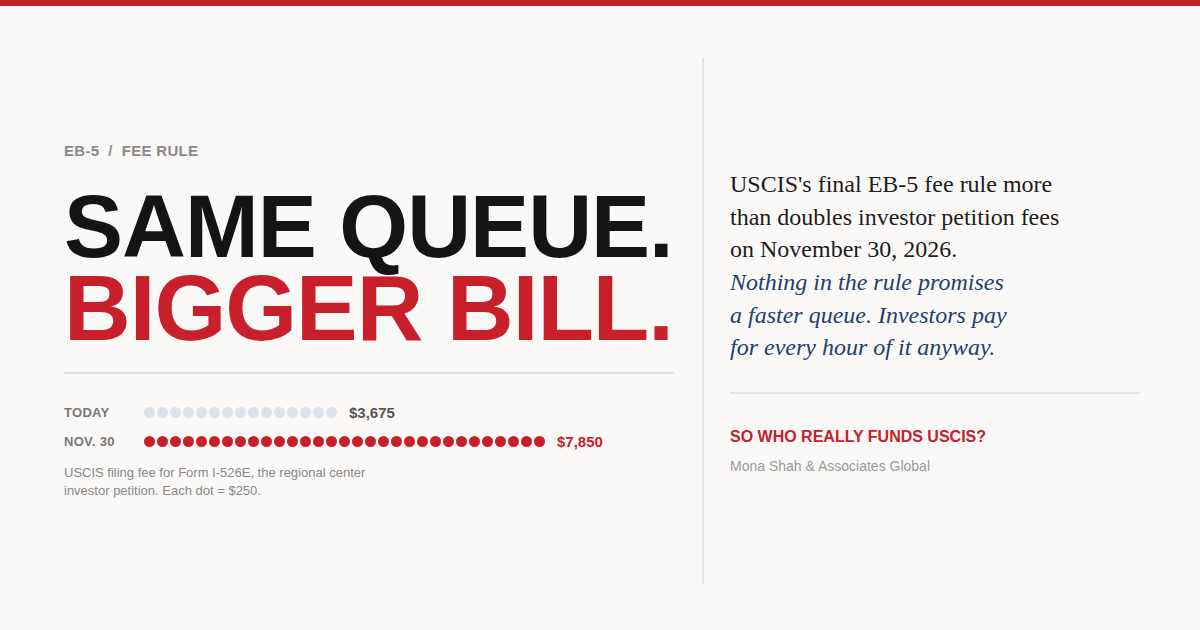
USCIS’s final EB-5 fee rule, effective November 30, 2026, more than doubles investor petition fees and raises regional center filing fees by as much as 148 percent. To understand why, start with a fact most investors do not know: the agency is funded almost entirely by the people who file with it.
By: Mona Shah, Esq.
September 30, 2026
Ask most EB-5 investors who pays for the agency that decides their petition, and the answer is usually “the government.” It is not. In fiscal year 2025, filing fees deposited into the USCIS Immigration Examinations Fee Account supplied approximately 95 percent of the agency’s total funding. Congressional appropriations accounted for about 4 percent, and the EB-5 Integrity Fund, which Congress created in 2022 to police the regional center program, for less than 1 percent. [1]
For EB-5, the contribution from Congress is zero!
In the final fee rule published on September 30, 2026, DHS states that USCIS receives no Congressional appropriation for the EB-5 program, and that when fees do not recover costs, it cannot maintain the capacity to process petitions within the timeframes Congress set. [1] Every adjudicator hour, every site visit and every background check on a regional center principal is paid for by the investors, developers and regional centers who file.
That single fact explains most of the new rule. Read it not as a price list but as an invoice, sent by the only agency in the country that can approve your petition.
Will the bigger bill dampen enthusiasm for the program? In my view, not by itself. A family committing at least $800,000 does not abandon a green card over a few thousand dollars in filing fees, and DHS itself calls the fees very small relative to most investment amounts. [1] The more expensive date is January 1, 2027, when the statutory minimum investment amounts reset for inflation for the first time. [2]
Mark the date. The new fees apply to anything postmarked on or after Monday, November 30, 2026, the Monday after Thanksgiving. [1] Spare a thought for EB-5 attorneys, who will be spending the holiday weekend assembling petitions instead of carving the turkey!
THE FACT MOST INVESTORS MISS
About 95 percent of USCIS funding in FY 2025 came from filing fees. Appropriations supplied about 4 percent.
The EB-5 program receives no Congressional appropriation at all. Its costs are recovered from filers. [1]
What Changes on November 30
The rule, 91 FR 61940, is DHS’s answer to a simple question: what does it cost to process roughly 16,600 EB-5 filings a year? About 70.7 percent more than investors pay today, on a weighted average. [1] The capital thresholds of $1,050,000 and $800,000 do not change, at least not until January 1, 2027. [2]
Table 1. EB-5 Fees: 2024 Rule, Current, Proposed and Final
| Form | 2024 rule (stayed) | Current | Proposed (Oct. 2025) | Final (Nov. 30, 2026) | Change vs. current |
| I-526, standalone investor | $11,160 | $3,675 | $9,625 | $7,615 | +107% |
| I-526E, regional center investor (initial) | $11,160 | $3,675 | $9,625 | $7,850 | +114% |
| I-526E amendment | n/a | $3,675 | $9,530 | $7,775 | +112% |
| I-829, removal of conditions | $9,525 | $3,750 | $7,860 | $5,000 | +33% |
| I-527, amendment to legacy I-526 (new) | n/a | n/a | $8,000 | $10,330 | New form |
| I-956, regional center designation | $47,695 | $17,795 | $28,895 | $44,115 | +148% |
| I-956 amendment | $47,695 | $17,795 | $18,480 | $9,835 | -45% |
| I-956F, project application | $47,695 | $17,795 | $29,935 | $42,675 | +140% |
| I-956G, annual statement | $4,470 | $3,035 | $2,740 | $2,165 | -29% |
| I-956H, bona fides | n/a | $0 | $55 | $65 | New fee |
| I-956K, promoter registration | n/a | $0 | $2,740 | $2,165 | New fee |
| Integrity Fund fee, per I-526E | $1,000 | $1,000 | $1,085 | $1,100 | +10% |
| Integrity Fund fee, regional center (20 or fewer investors) | $10,000 | $10,000 | $10,825 | $11,000 | +10% |
| Integrity Fund fee, regional center (more than 20 investors) | $20,000 | $20,000 | $21,650 | $22,000 | +10% |
Sources: final and current fees [1][9][10][12]; proposed fees [5][12]; 2024 fees [3][5][6]. “Current” reflects the fees USCIS has accepted since November 12, 2025. Integrity Fund fees were set by statute in 2022 and were not changed by the 2024 rule. [2]
Read the fine print. The I-526 and I-526E fees include a new $75 “technology fee” Yes folks, the EB-5 Industry is paying for USCIS’ new AI model, and the regional center investor still pays the Integrity Fund fee on top, now $1,100. The government’s take on a regional center petition therefore rises from $4,675 to $8,950. [1][2][12]
The Story the Headlines Missed
Most coverage compares the new fees with today’s. Compare them instead with what DHS proposed in October 2025. [4] Investors came out ahead: the I-526 and I-526E were proposed at $9,625 and the I-829 at $7,860. [5][12] Regional centers did not. The I-956 went from a proposed $28,895 to $44,115, the I-956F from $29,935 to $42,675, and the new I-527 from $8,000 to $10,330. [1][5] The reason is instructive. Commenters asked DHS to use newer data; the newer data put EB-5 program costs at about $105 million rather than $86 million. [1] Be careful what you ask for!
Was the Increase Inevitable?
Some increase was. In section 106 of the 2022 Act, Congress told DHS to set EB-5 fees that recover the program’s full cost and aim for statutory processing time goals. [1] The fee study puts that cost at $105.0 million against $56.6 million in revenue at current fees. [1] With no appropriation to close a $48.4 million gap, there is only one place for the money to come from.
What was not inevitable is the size. The cost of everything in the United States has gone up, but general inflation does not explain a doubling. The one EB-5 charge DHS tied directly to inflation, the Integrity Fund fee, rose 10 percent. [1]
Inflation does not explain a doubling. The one fee DHS tied to inflation rose 10 percent.
So what explains the rest? The cost base behind the rule includes 6,045 new USCIS positions by the end of FY 2027, expanded fraud and national security vetting under Executive Orders 14157 and 14161, a 3 percent pay assumption, and agency-wide projects ranging from lockbox operations to a new Voter Verification System. [1] Those are agency-wide figures, and the rule does not say how much of each lands on EB-5 filers. EB-5 filers see only the total.
Put Plainly, Investors are now paying by the hour for increased RFEs and NOIDs
There is also more work per petition and, in our practice, a great many more RFEs and NOIDs. DHS now estimates 8.76 adjudication hours for an I-526 and 9.14 for an I-526E, against the 5.01 hours commenters identified in the FY 2022/2023 fee rule, and it attributes the higher I-526E figure to reviewing the source-of-funds documentation required by INA 203(b)(5)(L)(ii). [1] Put plainly, investors are now paying, by the hour, for the scrutiny of their own money.
One choice kept fees lower, and DHS is candid about why. The 2022 Act allowed it to load EB-5 fees with part of the cost of the services USCIS provides free of charge. DHS declined, not out of generosity, but out of what it calls an abundance of caution, to reduce litigation risk, and because those costs are already covered by other fees. [1] Having just lost in court over EB-5 fees, the agency was in no hurry to invite a second lawsuit.
How We Got Here
The last attempt went badly. The 2024 fee rule took the I-526 and I-526E to $11,160, the I-829 to $9,525, and the I-956, the I-956F and even each I-956 amendment to $47,695. [5][6] Investors and the American Immigrant Investor Alliance sued, and on November 12, 2025, the District of Colorado stayed the EB-5 fees in Moody v. Noem, No. 24-cv-00762-CNS, finding that the 2022 Act precluded DHS from adjusting them in that rule; commentators point to the missing program-specific fee study. [3][7][8] USCIS reverted to the old fees. DHS still says the court was wrong, and it will not refund anyone who paid the higher ones. [1] This rule is take two!
Will Higher Fees Change Investor Decisions?
Not by themselves, as I said at the outset. The investment amount is another matter.
Under 8 U.S.C. 1153(b)(5)(C)(iii), the $1,050,000 standard amount resets on January 1, 2027 by the cumulative change in CPI-U since January 1, 2022, rounded down to the nearest $50,000, and the TEA amount becomes 75 percent of the new figure. [2] DHS is to publish the new amounts by technical amendment in the Federal Register. As of this writing, it has not.
Where I expect the fee schedule to change behavior is at the sponsor level. At the investor level, the difference between routes is modest: $7,615 for a standalone I-526 against $8,950 for an I-526E with its Integrity Fund fee. The real difference sits above the investor. A regional center project carries the $42,675 I-956F, annual Integrity Fund fees of $11,000 or $22,000, and new fees for bona fides and promoter registration filings. [1][2][10] A direct, standalone enterprise carries none of these. The trade-off is jobs: the allowance to satisfy up to 90 percent of job creation with indirect jobs belongs to the regional center program. [2] For businesses that can create ten direct jobs per investor, I expect to see more standalone petitions.
Faster Processing? We Live in Hope
USCIS says the new fees will help it meet the statutory processing time goals. We live in hope. In our practice, the 2024 increases bought no noticeable speed, and this rule is careful not to promise any. DHS declined to write the processing goals into the regulation, preferring to mention them in the preamble, and it warns that actual processing times depend on volume, staffing and case complexity. [1] Its adjudication-hour estimates exclude the time a case spends waiting in the queue, which is the only time investors actually notice. [1] Meanwhile, it expects receipts to climb to about 16,600 a year. [1] More money chasing more petitions is not the same thing as faster petitions.
The bottleneck that matters most to developers is the I-956F. The statute requires a regional center to file an I-956F for each offering before any investor petitions on it, and an approved I-956F binds USCIS in the later adjudication of those investors’ petitions, subject to limited exceptions. [2] In our experience, USCIS is seriously slow in adjudicating I-956F project applications, and a developer marketing an offering whose project application is still pending raises capital without that certainty. If the higher I-956F fee is justified anywhere, it should be justified by faster project approvals.
If the higher I-956F fee is justified anywhere, it should be justified by faster project approvals.
Can Regional Centers Absorb It?
Most can. In my experience, developers use EB-5 because it is lower-cost capital than the alternatives available to them, particularly when interest rates are high. Against that saving, even a $42,675 I-956F fee is a small line item: on a raise of $16 million from 20 investors at $800,000 each, it is about 0.27 percent.
One change deserves real credit. EB-5 projects are dynamic businesses, and the statute anticipates change: a regional center must notify DHS at least 120 days before significant changes to its organizational structure, ownership or administration, and DHS may establish procedures to amend an approved I-956F to reflect changes to an offering. [2] Over a project’s life, amendments are routine. Charging $47,695 for each regional center amendment, as the 2024 schedule did, penalized regional centers for keeping USCIS informed. The final fee for an I-956 amendment is $9,835, below even today’s $17,795 and roughly one fifth of the 2024 figure. [1][5][10]
Two other features deserve attention. First, DHS has folded the cost of terminating and reaffirming regional centers, about $4.8 million a year, into the fees for initial I-956 and I-956F filings. [1] It cannot practically bill a regional center at the moment it terminates it for not paying, and it reads the Integrity Fund as off-limits for adjudicative work. [1] So the newcomers pay: every new designation and every new project now carries a share of the cost of policing everyone else.
Second, the rule codifies Integrity Fund penalties. A regional center that pays its annual fee from November 1 to November 30 owes a 10 percent penalty; from December 1 to December 30, a 20 percent penalty; and a fee that remains unpaid after December 30 leads to termination. [1][10] USCIS did not charge the late penalty for FY 2026 fees. [11]
The Investors Who Pay to Be Rescued
The 2022 Act allows pre-reform investors whose regional center is terminated, or whose enterprise is debarred, to amend their petitions and preserve eligibility where they were not knowing participants in the conduct that led to the action. [1] The new Form I-527 is the vehicle, and it will cost $10,330: more than DHS proposed, more than a new I-526E, and without the fee waivers or reductions commenters requested, which DHS declined. [1] As of July 20, 2026, about 10 percent of investors responding to the first round of USCIS notices indicated interest in amending, and DHS has confirmed that an I-527 will retain the original priority date. [1]
These are the investors Congress set out to protect. Asking them to pay more than $10,000 for that protection is difficult to reconcile with that purpose.
Key Dates
| Date | What happens |
| September 30, 2026 | Final rule published; current statutory EB-5 grandfathering date under the 2022 Act. [1][13] |
| October 31, 2026 | Last day to pay the FY 2027 regional center Integrity Fund fee without penalty (fee due October 1). [1][11] |
| November 30, 2026 | New fees apply to filings postmarked on or after this date, the Monday after Thanksgiving. [1] |
| January 1, 2027 | First automatic CPI-U adjustment of the minimum investment amounts; DHS to publish by technical amendment. [2] |
| September 30, 2027 | Current statutory end date of the Regional Center Program. [2] |
The Invoice and the Receipt
USCIS has sent the invoice; filers are entitled to a receipt. Congress tied EB-5 fees to processing time goals for a reason. The test of this rule will not be the fee table. It will be whether the I-956F queue moves, and whether the RFEs and NOIDs ease off now that investors are paying for every hour of them.
For investors and regional centers ready to file, the advice is simple: file before November 30. Your lawyer’s Thanksgiving is already spoken for.
U.S. and U.K. global immigration law firm specializing in EB-5 and the residency and citizenship by investment programs.
Sources
[1] U.S. Department of Homeland Security, U.S. Citizenship and Immigration Services Employment-Based Immigrant Visa, Fifth Preference (EB-5) Fee Rule, Final Rule, 91 FR 61940 (Sept. 30, 2026), FR Doc. 2026-20016, DHS Docket No. USCIS-2025-0139. https://www.federalregister.gov/documents/2026/09/30/2026-20016/us-citizenship-and-immigration-services-employment-based-immigrant-visa-fifth-preference-eb-5-fee
[2] 8 U.S.C. § 1153(b)(5) (INA § 203(b)(5)), including subparagraphs (C)(iii), (E), (F) and (J). Legal Information Institute. https://www.law.cornell.edu/uscode/text/8/1153
[3] USCIS, Court Order on Partial Stay of DHS 2024 USCIS Fee Rule (updated Nov. 18, 2025). https://www.uscis.gov/newsroom/alerts/court-order-on-partial-stay-of-dhs-2024-uscis-fee-rule
[4] DHS, EB-5 Fee Rule, Proposed Rule, 90 FR 48516 (Oct. 23, 2025), Regulations.gov Doc. USCIS-2025-0139-0001. https://www.regulations.gov/document/USCIS-2025-0139-0001
[5] WR Immigration, DHS Proposes Reductions to USCIS EB-5 Filing Fees and Creation of New Petitions (2025). https://wolfsdorf.com/dhs-proposes-reductions-to-uscis-eb-5-filing-fees-and-creation-of-new-petitions/
[6] EB-5 Insights, USCIS Announces Significant Filing Fee Increases for EB-5 Cases (Feb. 7, 2024). https://www.eb5insights.com/2024/02/07/uscis-announces-significant-filing-fee-increases-for-eb-5-cases/
[7] Bradley Arant Boult Cummings, Immediate EB-5 Filing Fees Reversion (Nov. 2025). https://www.bradley.com/insights/publications/2025/11/immediate-eb5-filing-fees-reversion
[8] American Immigrant Investor Alliance, We Won the EB-5 Fee Increase Lawsuit (Nov. 2025). https://goaiia.org/we-won-the-eb-5-fee-increase-lawsuit/
[9] Business Standard, US EB-5 fees jump 114%: What the new rules mean for Indian investors (Sept. 30, 2026), reporting Fragomen’s analysis of the final rule. https://www.business-standard.com/amp/immigration/us-eb-5-fees-jump-114-what-the-new-rules-mean-for-indian-investors-126093000238_1.html
[10] Erickson Immigration Group, USCIS Finalizes Major EB-5 Fee Increases and New Form I-527 (Sept. 29, 2026). https://eiglaw.com/uscis-finalizes-major-eb-5-fee-increases-and-new-form-i-527/
[11] USCIS, EB-5 Integrity Fund. https://www.uscis.gov/IntegrityFund
[12] Manifest Law, EB-5 Fees Will More Than Double on Nov. 30 (Sept. 29, 2026). https://manifestlaw.com/news/eb5-fee-increase-09-29-2026
[13] ARC Financial Enterprises, EB-5 Fee Change: Effective November 30, 2026 (Sept. 30, 2026). https://www.arcfe.com/post/eb-5-fee-change-effective-november-30-2026