
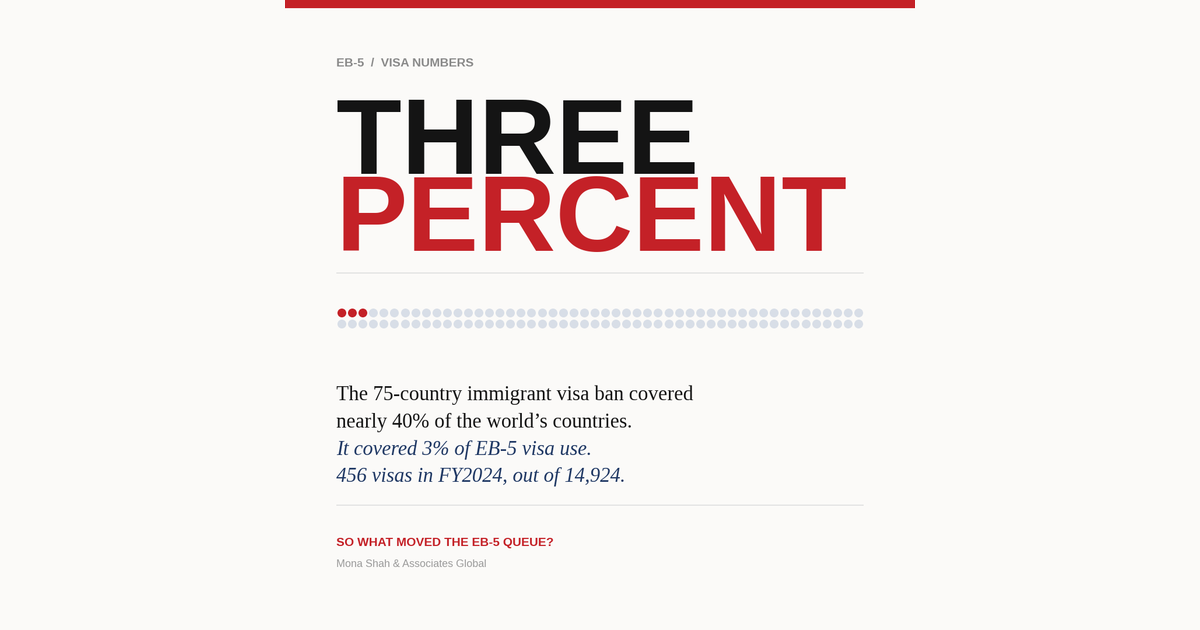
The 75-country immigrant visa ban accounted for three percent of EB-5 visa use. The EB-5 queue moved anyway.
Where the numbers actually came from, and why the largest piece of the transfer arrives in FY2027 regardless of the ruling that struck the ban down.
EB-5 visa number allocation under the 75-country immigrant visa ban, with FY2024 issuance data by country of chargeability, per-country limits for China and India, and the INA 201(d) effect on the FY2027 employment-based limit.
Mona Shah, Esq.
August 2026 | Mona Shah & Associates Global
On August 21, 2026, the Southern District of New York vacated the State Department policy that had barred immigrant visa issuance to nationals of 75 countries since January.1 The legal analysis of that ruling, and what it gives EB-5 clients in practice, is the subject of a companion article, Vacated Friday. Cancelled Monday.
This one deals with something nobody has costed: what the ban did to the visa numbers while it operated, and who collected.
Start with the question that gives this article its title.
How many EB-5 visas did the 75 listed countries actually use?
456 in FY2024, out of 14,924 worldwide, or about three percent. Of that, 83 belongs to countries still blocked by the travel ban proclamations, so the vacatur restores EB-5 access for countries representing 373 FY2024 visas.
That is the entire ban, measured against the program it was supposed to be reshaping. And yet the EB-5 queue moved further in FY2026 than in any year on record. The transfer of visa numbers was real, and much larger than the industry realizes. It simply did not happen where anyone assumes it did.
1. The Reallocation Nobody Costed
While the ban ran, the State Department said something remarkable in the Visa Bulletin, and the EB-5 industry read straight past it. The April 2026 bulletin stated that immigrant visa issuance rates for nationals of certain countries had decreased in light of administration actions including Presidential Proclamations 10949 and 10998 and the immigrant visa processing updates, and that consequently, in order to use the immigrant visa numbers available in FY2026, dates for filing and final action dates had been advanced across various categories.2
That is an agency stating on the record that it was moving cut-off dates because it had suppressed demand by nationality. EB5 United noticed in March that numbers which might otherwise have been used by applicants from those countries had been redistributed, and tied it to a forty-day Chart B advance for China. Nobody followed the thought further.
The movement was extraordinary. IIUSA reported that India Unreserved advanced nearly 900 days during the fiscal year before becoming unavailable in July. China Unreserved advanced past FY2016 filings to a final action date of December 1, 2016. Suzanne Lafleur of Lucid Text, who models this more carefully than anyone, revised her clearance estimates from around 2030 to 2027 for pre-2022 India, and from the mid-to-late 2030s to before 2030 for China.
The obvious inference is that the ban did that. The obvious inference is wrong, and it takes about twenty minutes with the right table to establish it.
2. The Table the Industry Has Not Opened
Table V, Part 3 of the State Department’s Report of the Visa Office 2024 gives fifth-preference number use by foreign state of chargeability, broken out across C5, T5, I5, R5, the non-reserved pool and all three set-asides.3 FY2024 is the most recent published year; the FY2025 report has still not appeared. Totaled against the 75-country list at footnote 1 of the opinion, it yields this.
EB-5 number use by the 75 listed countries, FY2024
| Country | FY2024 | Status | Country | FY2024 | Status |
| Brazil | 157 | Syria | 5 | Still blocked | |
| Russia | 58 | Bangladesh | 4 | ||
| Nigeria | 52 | Still blocked | Moldova | 4 | |
| Colombia | 44 | Lebanon | 3 | ||
| Iran | 23 | Still blocked | Tanzania | 3 | Still blocked |
| Kazakhstan | 21 | Uzbekistan | 3 | ||
| Pakistan | 15 | Albania | 2 | ||
| Egypt | 14 | Ethiopia | 2 | ||
| Kuwait | 9 | Liberia | 2 | ||
| Thailand | 8 | Tunisia | 2 | ||
| Jordan | 6 | Armenia | 1 | ||
| Azerbaijan | 5 | Bahamas | 1 | ||
| Ghana | 5 | Fiji | 1 | ||
| Iraq | 5 | Georgia | 1 | ||
| Remaining 47 listed countries | 0 | ||||
| TOTAL, all 75 listed countries | 456 | ||||
| less: countries still blocked by the proclamations | 83 | ||||
| EB-5 access actually restored by the vacatur | 373 | ||||
| Worldwide EB-5 number use, FY2024 | 14,924 | ||||
Immigrant visas issued plus adjustments of status, employment fifth preference, all categories. Source: U.S. Department of State, Report of the Visa Office 2024, Table V (Part 3). Country list from CLINIC v. Rubio, ECF No. 83 at 8 n.1. Shaded rows marked “Still blocked” were already covered by the travel ban proclamations, which this judgment does not disturb.
Three percent.
And of that, 83 visas belong to countries the proclamations still block, so the vacatur restores EB-5 access for countries representing 373 FY2024 visas, roughly two and a half percent of worldwide use. Four countries are 280 of the 373. Forty-seven of the seventy-five recorded no EB-5 number use whatever.
For scale, in the same year: China 9,547. Vietnam 1,533. India 1,428. Taiwan 513. South Korea 325. The five largest EB-5 markets were all outside the pause, and the largest of them consumed twenty times what all seventy-five listed countries did combined.
A few hundred numbers cannot produce a 900-day advance for India or move China through a year of 2016 filings. Within EB-5, the pause was close to noise. The redistribution the Department described was real; the EB-5 share of it was trivial.
Which means the money came in through a different door.
3. The Door It Came In Through
The provision is INA section 201(d). The worldwide employment-based level for a fiscal year is 140,000 plus the family-sponsored visas that went unused in the preceding year. EB-5 takes 7.1 percent of whatever that total turns out to be.
The pause fell most heavily on family-based categories. The complaint alleged it reached something in the order of forty to forty-five percent of immigrant visa applicants worldwide. Family-sponsored under-use in FY2026 therefore feeds directly into the FY2027 employment-based limit, and from there into the EB-5 allocation.
The ban’s largest EB-5 consequence is a supply increase that arrives because of the ban, lands after it was struck down, and accrues to precisely the backlogged Chinese and Indian queues the industry has spent the year worrying about.
That effect is already banked. Vacatur on August 21 does not retrieve family-sponsored numbers that went unused between January and August. The document to watch is the FY2027 annual numerical limits, published in the autumn. That, and not the judgment, is where the EB-5 consequence of the ban will finally become legible.
4. Who Actually Collected
One correction to an assumption I have heard repeatedly, including from careful practitioners. The intuition that India was the principal beneficiary is not right. India’s Unreserved supply is largely fixed by the per-country limit, and the Department published a dedicated notice confirming India had reached that limit in the EB-5 unreserved category in FY2026.4 Numbers above a country’s cap go to over-subscribed countries in priority date order, and China’s EB-5 dates sit roughly five years behind India’s. China stood first in the queue. India took its allocation and stopped.
India’s real exposure is elsewhere and it is larger. It sits in the set-asides, where Rest of World usage is the single biggest variable in every wait-time model, and in the timing of when the pre-RIA Unreserved backlog clears enough for post-RIA Indian set-aside investors to reach Unreserved numbers at all. Restore Rest of World consular demand and both move against India.
The Verdict
The ban cost this program a year of consular throughput in exactly the markets the industry spent a decade building after China. Brazil, Colombia, Russia, Kazakhstan, Egypt, Pakistan, Thailand. Those are the diversification markets, and the pause caught them because their household welfare-participation averages were high, a statistic with no bearing whatever on whether a particular family can document US$800,000.
At the same time, the suppression that stranded those investors quietly financed the advance of the Chinese and Indian queues, and its family-based portion will surface as an inflated employment-based limit in FY2027, months after the policy that produced it was declared patently unlawful.
Both of those things are true, and the industry has been discussing neither. That is usually a sign that the numbers are worth reading before the headlines.
Questions We Are Being Asked
Was India on the 75-country visa ban list?
No. India was not listed, and neither were China, Vietnam, Taiwan or South Korea. The five largest EB-5 markets were all outside the pause. India’s exposure was indirect, through the redistribution of immigrant visa numbers left unused by the listed countries.
Which listed countries use EB-5 most?
Brazil at 157 FY2024 visas, then Russia at 58, Nigeria at 52, Colombia at 44 and Kazakhstan at 21. Those five account for most of the listed-country total. Forty-seven of the seventy-five recorded no EB-5 number use at all in FY2024.
Did the ban help Indian EB-5 applicants?
Less than is assumed. India reached its per-country limit in EB-5 unreserved in FY2026 and stopped there. Numbers above a country’s cap pass to oversubscribed countries in priority date order, and China’s EB-5 dates sit roughly five years behind India’s.
Why did the China EB-5 final action date advance so quickly in FY2026?
The State Department said in the April 2026 Visa Bulletin that issuance rates for nationals of certain countries had decreased because of administration actions, and that dates were advanced to use the available numbers. Within EB-5 itself, however, the listed countries account for only about three percent of use.
Does the ruling reverse the visa number gains?
Not retroactively. Vacatur does not retrieve numbers that went unused between January and August 2026. The larger effect runs through INA section 201(d): family-sponsored visas unused in FY2026 raise the FY2027 employment-based limit, of which EB-5 takes 7.1 percent.
Where is EB-5 visa issuance by country published?
In the State Department’s Report of the Visa Office, Table V, Part 3, which gives fifth-preference number use by foreign state of chargeability. FY2024 is the most recent published year.
EB-5 number use by the 75 countries subject to the January 2026 immigrant visa pause
Fiscal Year 2024 immigrant visas issued plus adjustments of status, employment fifth preference. Source: U.S. Department of State, Report of the Visa Office 2024, Table V (Part 3).
Country list from Catholic Legal Immigration Network, Inc. v. Rubio, No. 26-cv-00858 (JAV) (S.D.N.Y. Aug. 21, 2026), ECF No. 83 at 8 n.1. FY2024 is the most recent published Report of the Visa Office; the FY2025 report had not been published as of August 2026.
| Country | Region | C5 | T5 | I5 | R5 | Non-Reserved Pool | Unreserved subtotal | Rural | High Unemp. | Infrastructure | Set-aside subtotal | EB-5 total | Still blocked by 39-country proclamations? |
|---|---|---|---|---|---|---|---|---|---|---|---|---|---|
| Brazil | South America | 6 | 0 | 143 | 0 | 3 | 152 | 2 | 3 | 0 | 5 | 157 | No |
| Russia | Europe | 0 | 2 | 52 | 0 | 0 | 54 | 0 | 4 | 0 | 4 | 58 | No |
| Nigeria | Africa | 0 | 0 | 52 | 0 | 0 | 52 | 0 | 0 | 0 | 0 | 52 | Yes |
| Colombia | South America | 0 | 7 | 32 | 0 | 0 | 39 | 5 | 0 | 0 | 5 | 44 | No |
| Iran | Asia | 0 | 4 | 19 | 0 | 0 | 23 | 0 | 0 | 0 | 0 | 23 | Yes |
| Kazakhstan | Europe | 0 | 3 | 18 | 0 | 0 | 21 | 0 | 0 | 0 | 0 | 21 | No |
| Pakistan | Asia | 1 | 6 | 8 | 0 | 0 | 15 | 0 | 0 | 0 | 0 | 15 | No |
| Egypt | Africa | 0 | 0 | 14 | 0 | 0 | 14 | 0 | 0 | 0 | 0 | 14 | No |
| Kuwait | Asia | 0 | 0 | 9 | 0 | 0 | 9 | 0 | 0 | 0 | 0 | 9 | No |
| Thailand | Asia | 0 | 0 | 8 | 0 | 0 | 8 | 0 | 0 | 0 | 0 | 8 | No |
| Jordan | Asia | 0 | 0 | 6 | 0 | 0 | 6 | 0 | 0 | 0 | 0 | 6 | No |
| Azerbaijan | Europe | 0 | 0 | 5 | 0 | 0 | 5 | 0 | 0 | 0 | 0 | 5 | No |
| Ghana | Africa | 0 | 0 | 5 | 0 | 0 | 5 | 0 | 0 | 0 | 0 | 5 | No |
| Iraq | Asia | 0 | 0 | 5 | 0 | 0 | 5 | 0 | 0 | 0 | 0 | 5 | No |
| Syria | Asia | 0 | 0 | 5 | 0 | 0 | 5 | 0 | 0 | 0 | 0 | 5 | Yes |
| Bangladesh | Asia | 0 | 0 | 4 | 0 | 0 | 4 | 0 | 0 | 0 | 0 | 4 | No |
| Moldova | Europe | 0 | 0 | 4 | 0 | 0 | 4 | 0 | 0 | 0 | 0 | 4 | No |
| Lebanon | Asia | 0 | 2 | 1 | 0 | 0 | 3 | 0 | 0 | 0 | 0 | 3 | No |
| Tanzania | Africa | 0 | 0 | 3 | 0 | 0 | 3 | 0 | 0 | 0 | 0 | 3 | Yes |
| Uzbekistan | Europe | 0 | 0 | 3 | 0 | 0 | 3 | 0 | 0 | 0 | 0 | 3 | No |
| Albania | Europe | 0 | 0 | 2 | 0 | 0 | 2 | 0 | 0 | 0 | 0 | 2 | No |
| Ethiopia | Africa | 0 | 0 | 2 | 0 | 0 | 2 | 0 | 0 | 0 | 0 | 2 | No |
| Liberia | Africa | 0 | 0 | 2 | 0 | 0 | 2 | 0 | 0 | 0 | 0 | 2 | No |
| Tunisia | Africa | 0 | 2 | 0 | 0 | 0 | 2 | 0 | 0 | 0 | 0 | 2 | No |
| Armenia | Europe | 0 | 0 | 1 | 0 | 0 | 1 | 0 | 0 | 0 | 0 | 1 | No |
| Bahamas, The | North America | 0 | 0 | 1 | 0 | 0 | 1 | 0 | 0 | 0 | 0 | 1 | No |
| Fiji | Oceania | 0 | 0 | 1 | 0 | 0 | 1 | 0 | 0 | 0 | 0 | 1 | No |
| Georgia | Europe | 0 | 0 | 1 | 0 | 0 | 1 | 0 | 0 | 0 | 0 | 1 | No |
| Afghanistan | Asia | 0 | 0 | 0 | 0 | 0 | 0 | 0 | 0 | 0 | 0 | 0 | Yes |
| Algeria | Africa | 0 | 0 | 0 | 0 | 0 | 0 | 0 | 0 | 0 | 0 | 0 | No |
| Antigua and Barbuda | North America | 0 | 0 | 0 | 0 | 0 | 0 | 0 | 0 | 0 | 0 | 0 | Yes |
| Barbados | North America | 0 | 0 | 0 | 0 | 0 | 0 | 0 | 0 | 0 | 0 | 0 | No |
| Belarus | Europe | 0 | 0 | 0 | 0 | 0 | 0 | 0 | 0 | 0 | 0 | 0 | No |
| Belize | North America | 0 | 0 | 0 | 0 | 0 | 0 | 0 | 0 | 0 | 0 | 0 | No |
| Bhutan | Asia | 0 | 0 | 0 | 0 | 0 | 0 | 0 | 0 | 0 | 0 | 0 | No |
| Bosnia and Herzegovina | Europe | 0 | 0 | 0 | 0 | 0 | 0 | 0 | 0 | 0 | 0 | 0 | No |
| Burma | Asia | 0 | 0 | 0 | 0 | 0 | 0 | 0 | 0 | 0 | 0 | 0 | Yes |
| Cambodia | Asia | 0 | 0 | 0 | 0 | 0 | 0 | 0 | 0 | 0 | 0 | 0 | No |
| Cameroon | Africa | 0 | 0 | 0 | 0 | 0 | 0 | 0 | 0 | 0 | 0 | 0 | No |
| Cabo Verde | Africa | 0 | 0 | 0 | 0 | 0 | 0 | 0 | 0 | 0 | 0 | 0 | No |
| Cote d’Ivoire | Africa | 0 | 0 | 0 | 0 | 0 | 0 | 0 | 0 | 0 | 0 | 0 | Yes |
| Cuba | North America | 0 | 0 | 0 | 0 | 0 | 0 | 0 | 0 | 0 | 0 | 0 | Yes |
| Congo, Dem. Rep. of the | Africa | 0 | 0 | 0 | 0 | 0 | 0 | 0 | 0 | 0 | 0 | 0 | Yes |
| Dominica | North America | 0 | 0 | 0 | 0 | 0 | 0 | 0 | 0 | 0 | 0 | 0 | Yes |
| Eritrea | Africa | 0 | 0 | 0 | 0 | 0 | 0 | 0 | 0 | 0 | 0 | 0 | Yes |
| Gambia, The | Africa | 0 | 0 | 0 | 0 | 0 | 0 | 0 | 0 | 0 | 0 | 0 | Yes |
| Grenada | North America | 0 | 0 | 0 | 0 | 0 | 0 | 0 | 0 | 0 | 0 | 0 | No |
| Guatemala | North America | 0 | 0 | 0 | 0 | 0 | 0 | 0 | 0 | 0 | 0 | 0 | No |
| Guinea | Africa | 0 | 0 | 0 | 0 | 0 | 0 | 0 | 0 | 0 | 0 | 0 | No |
| Haiti | North America | 0 | 0 | 0 | 0 | 0 | 0 | 0 | 0 | 0 | 0 | 0 | Yes |
| Jamaica | North America | 0 | 0 | 0 | 0 | 0 | 0 | 0 | 0 | 0 | 0 | 0 | No |
| Kosovo | Europe | 0 | 0 | 0 | 0 | 0 | 0 | 0 | 0 | 0 | 0 | 0 | No |
| Kyrgyzstan | Europe | 0 | 0 | 0 | 0 | 0 | 0 | 0 | 0 | 0 | 0 | 0 | No |
| Laos | Asia | 0 | 0 | 0 | 0 | 0 | 0 | 0 | 0 | 0 | 0 | 0 | Yes |
| Libya | Africa | 0 | 0 | 0 | 0 | 0 | 0 | 0 | 0 | 0 | 0 | 0 | Yes |
| Mongolia | Asia | 0 | 0 | 0 | 0 | 0 | 0 | 0 | 0 | 0 | 0 | 0 | No |
| Montenegro | Europe | 0 | 0 | 0 | 0 | 0 | 0 | 0 | 0 | 0 | 0 | 0 | No |
| Morocco | Africa | 0 | 0 | 0 | 0 | 0 | 0 | 0 | 0 | 0 | 0 | 0 | No |
| Nepal | Asia | 0 | 0 | 0 | 0 | 0 | 0 | 0 | 0 | 0 | 0 | 0 | No |
| Nicaragua | North America | 0 | 0 | 0 | 0 | 0 | 0 | 0 | 0 | 0 | 0 | 0 | No |
| North Macedonia | Europe | 0 | 0 | 0 | 0 | 0 | 0 | 0 | 0 | 0 | 0 | 0 | No |
| Congo, Rep. of the | Africa | 0 | 0 | 0 | 0 | 0 | 0 | 0 | 0 | 0 | 0 | 0 | Yes |
| Rwanda | Africa | 0 | 0 | 0 | 0 | 0 | 0 | 0 | 0 | 0 | 0 | 0 | No |
| Saint Kitts and Nevis | North America | 0 | 0 | 0 | 0 | 0 | 0 | 0 | 0 | 0 | 0 | 0 | No |
| Saint Lucia | North America | 0 | 0 | 0 | 0 | 0 | 0 | 0 | 0 | 0 | 0 | 0 | No |
| Saint Vincent and the Grenadines | North America | 0 | 0 | 0 | 0 | 0 | 0 | 0 | 0 | 0 | 0 | 0 | No |
| Senegal | Africa | 0 | 0 | 0 | 0 | 0 | 0 | 0 | 0 | 0 | 0 | 0 | Yes |
| Sierra Leone | Africa | 0 | 0 | 0 | 0 | 0 | 0 | 0 | 0 | 0 | 0 | 0 | Yes |
| Somalia | Africa | 0 | 0 | 0 | 0 | 0 | 0 | 0 | 0 | 0 | 0 | 0 | Yes |
| South Sudan | Africa | 0 | 0 | 0 | 0 | 0 | 0 | 0 | 0 | 0 | 0 | 0 | Yes |
| Sudan | Africa | 0 | 0 | 0 | 0 | 0 | 0 | 0 | 0 | 0 | 0 | 0 | Yes |
| Togo | Africa | 0 | 0 | 0 | 0 | 0 | 0 | 0 | 0 | 0 | 0 | 0 | Yes |
| Uganda | Africa | 0 | 0 | 0 | 0 | 0 | 0 | 0 | 0 | 0 | 0 | 0 | No |
| Uruguay | South America | 0 | 0 | 0 | 0 | 0 | 0 | 0 | 0 | 0 | 0 | 0 | No |
| Yemen | Asia | 0 | 0 | 0 | 0 | 0 | 0 | 0 | 0 | 0 | 0 | 0 | Yes |
| TOTAL, all 75 listed countries | 7 | 26 | 406 | 0 | 3 | 442 | 7 | 7 | 0 | 14 | 456 | ||
| of which: still blocked by the 39-country proclamations | 83 | ||||||||||||
| of which: access restored by the August 21, 2026 vacatur | 373 | ||||||||||||
Notes
1. Grey shaded rows: country was already subject to a full or partial travel ban proclamation before the January 2026 pause, so the August 21, 2026 vacatur does not restore immigrant visa access.
2. Travel-ban status per the country list published by Mintz, Levin (January 29, 2026), which marked the countries newly added by the January 2026 pause. Verify against Presidential Proclamations 10949 and 10998 before publication.
3. Table V counts visa issuances AND adjustments of status. The January 2026 pause applied only to consular issuance, so the share of these numbers actually suppressed is lower than the totals shown.
4. FY2024 was a record year for EB-5 number use (14,924 total). FY2025 and FY2026 country detail is not yet published.