

How Two Weeks of Quiet Lobbying Softened the Memo, Why the Walk-Back Is Not Enough, and What the Whole Episode Reveals About America’s Need for Foreign Workers
By: Mona Shah, Esq.
In the space of two weeks, the United States government moved from announcing that adjustment of status would be granted “only in extraordinary circumstances” to describing the same measure, on background to The New York Times as a “housekeeping matter, not a change of strategy.” It is the same administration and same memorandum but very different vocabulary. The collapse of one phrase into the other is the most candid summary of American immigration policy in 2026 that the agency has yet produced, and it was not supposed to be public.
An agency that speaks with two voices in nine days does not have a policy. It has a press strategy.
An agency that speaks with two voices in nine days does not have a policy, rather, a press strategy. The May 22 release was loud, sweeping, and deliberately frightening. The walk-back that began on May 29 and accelerated into June was quiet, partial, and delivered to selected reporters and selected business leaders rather than through any formal rescission. Both messages remain on the table, which is precisely the point. This is what governing by press release looks like once the press has actually read it.
I. Two Weeks. Two Messages. One Memorandum.
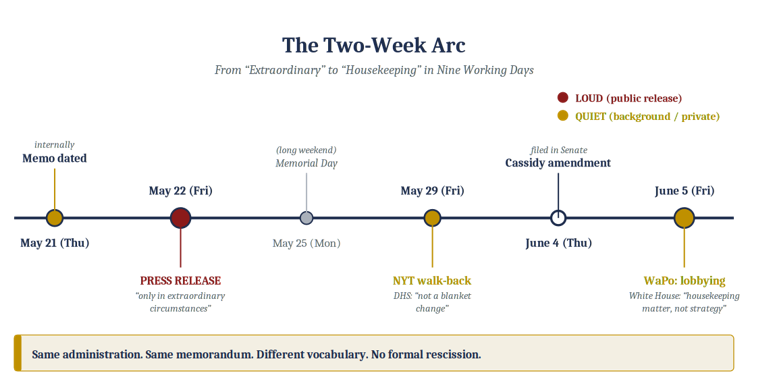
The chronology is short enough to recite. On Thursday, May 21, USCIS dated Policy Memorandum PM-602-0199. On Friday, May 22, the Friday before the Memorial Day weekend, the agency pushed it into public view, with a press release announcing that adjustment of status would be granted only in extraordinary circumstances and that the in-country green card was now an act of administrative grace. The headlines wrote themselves through the long weekend.
One week later, on Friday, May 29, the Department of Homeland Security told the New York Times that the policy was not a blanket change, that individual officers had always carried the discretion the memorandum described, and that only some applicants would be required to leave the country to await their green cards. Less than a week after that, by June 5, the Washington Post had reported that a senior White House official described the entire effort as a housekeeping matter rather than a change of strategy. Officials had not, and as of this writing have not, issued any superseding formal guidance saying so.
Either the May 22 release misrepresented what the memorandum did, or the May 29 and June 5 statements misrepresent what the May 22 release said. The administration would prefer that neither question be asked too loudly, because each one is a candid description of an arbitrary-and-capricious act.
II. How Big Business Quietly Rewrote a Federal Memo
“In the days after the May 22 release, big business, including the tech and artificial intelligence industries, the U.S. Chamber of Commerce, and named Fortune 500 firms, launched what the Washington Post described as a quiet but extensive lobbying effort.”
The Washington Post’s reporting on June 5 supplies the part the agency would rather you ignore. In the days after the May 22 release, big business, including the tech and artificial intelligence industries, the U.S. Chamber of Commerce, and named Fortune 500 firms, launched what the Washington Post described as a quiet but extensive lobbying effort. Calls and emails moved across the White House, the Department of Homeland Security, the Department of Labor, and the Department of State. The Chamber pressed for further guidance. The tech industry made its concerns known directly to the White House.
The channels that did the work were unsurprising and revealing. According to the Post’s sources, business leaders reached the administration through Commerce Secretary Howard Lutnick and through members of the Kushner family, both perceived as friendlier to the business community than the immigration hawks elsewhere in the administration. The Domestic Policy Council was reportedly contacted directly. Late in that first week, USCIS officials privately reassured business leaders in a meeting that most work visas would not be affected. The reassurance was delivered in private, on background, and without a paper trail.
“Govern by shock, soften by spreadsheet.”
Again, we see a pattern that is recognizable. The same administration paused immigration raids in hospitality and agriculture last summer after employers protested, walked back the announced one-hundred-thousand-dollar H-1B fee to apply only to new visas after business outcry, and publicly distanced itself from a large raid on a Hyundai facility in Georgia. Govern by shock, soften by spreadsheet. The May 22 release was the shock. The June walk-back is the spreadsheet.
III. EB-5 Counsel Was Already in Position
While the general-interest press was still typing up the word “extraordinary,” the immigration bar, and EB-5 counsel in particular, had already located the statutory floor that the memorandum could not move. Section 245(n) of the Immigration and Nationality Act, added by Congress in the EB-5 Reform and Integrity Act of 2022, provides in mandatory terms that an EB-5 investor’s adjustment application shall be considered properly filed when filed concurrently or after the petition, provided a visa is available. The companion provision, Section 245(k), now extends to EB-5 the same one-hundred-eighty-day forgiveness window the other employment categories have always enjoyed.
Those provisions did the work that the broader business pushback then amplified. The lobbying that ultimately produced the walk-back rests on the same underlying point that EB-5 counsel articulated within days of the May 22 release: that the memorandum operates at the discretionary grant stage, that the statute controls filing, and that an agency cannot rewrite by memorandum what Congress wrote into the U.S. Code three years ago. The bar made the legal argument. The Chamber and the tech industry then made the political one.
IV. The Disaster That Was Briefly on the Table
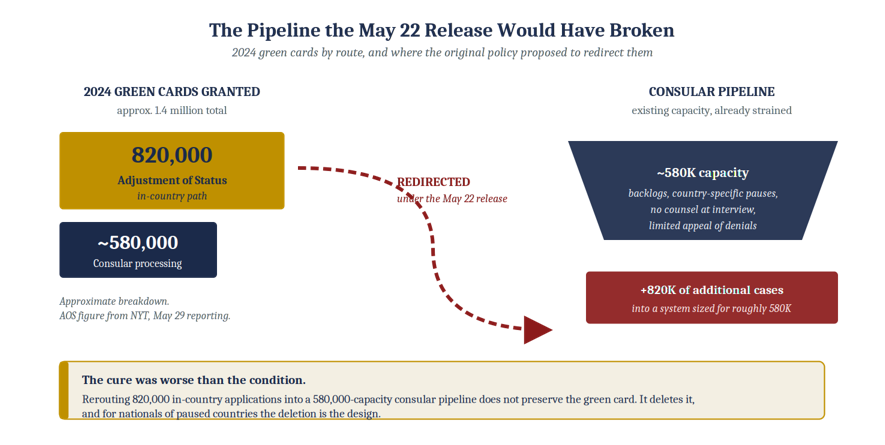
Take the May 22 release at its word for a moment and ask what the country was being told to absorb. Applicants who had waited years in employment-based queues would have been required to leave the United States, families intact or not, to await visa interviews at consulates abroad. Those consular adjudications carry their own constraints, including officer discretion that is harder to appeal, the absence of counsel at the interview, and processing timelines already strained by backlogs and country-specific pauses. That last point deserves emphasis. The Department of State has paused immigrant visa processing for nationals of dozens of countries identified as high-risk users of public benefits, and a policy that forces those same nationals out of the country to apply abroad is, in operational terms, a back-door travel ban. The applicant is told to leave, and then the consulate is told not to issue. The construction is elegant in a way only an immigration measure dressed as housekeeping can be, and the targeted countries discover that the door home is the same door that locks behind them. For applicants who had overstayed even briefly, the act of departing to comply would have triggered three- and ten-year bars to reentry. The cure would have been worse than the condition.
The cure would have been worse than the condition. The policy as announced would have stranded the very workers the administration claims to be courting.
The macroeconomic picture is no kinder. Roughly 1.4 million green cards were granted in 2024, with approximately 820,000 of them obtained through adjustment of status, the in-country path the memorandum targeted. Imagine that volume rerouted, on short notice, into a consular pipeline already operating with delay. The Post quoted an immigration lawyer representing employers nationwide who described the memorandum as a “clearly flawed” measure, and reported that executives saw it as the moment that would compel them to send work abroad. That is not idle threat language. The hiring platform Indeed has already documented a sharp decline in foreign job-seeker interest in United States positions, a leading indicator that runs against every public commitment the administration has made on technology, manufacturing, and competitiveness. If the policy as announced were meant to deter applicants, on the data, it is succeeding.
V. The United States Needs Foreign Workers; It’s an Inconvenient Truth!
The administration is in a contradiction that no amount of press management resolves. It cannot at once present itself as the leader of the global race in artificial intelligence and advanced manufacturing and chase away the people who actually build the products. The high-skilled foreign workers who fill the H-1B, L-1, and O-1 categories are, by the public statements of their own employers, central to American technological output. The Post quoted a managing partner at one of the country’s leading employer-side immigration firms describing those workers as being driven out, and reported that company executives have begun to weigh outsourcing as the rational response.
The demographic and labor picture confirms the same point from a different direction. The United States is not producing the workforce it requires in the skill categories its economy demands, and the gap is filled, lawfully and at length, by foreign nationals who navigate one of the most cumbersome immigration systems in the developed world. Employer-sponsored permanent residence is the tool that converts those workers from temporary contributors to permanent ones. Restricting that tool while simultaneously promising industrial dominance is not a policy. It is a contradiction in a press release.
The political rhetoric coming from the Trump administration on immigration is, on its own terms, severe. The operational behavior is different, because the operational behavior is constrained by the same employers and industries that the rhetoric purports to favor. Hospitality and agriculture protested, and the raids paused. The Chamber and the tech industry protested, and the memorandum became housekeeping. The lesson is not that the administration is moderate. It is that the economy will not let the rhetoric land where it points.
VI. Why the Walk-Back Is Not Enough
It would be a mistake to treat the softening as a resolution. The May 22 release has not been rescinded. The memorandum has not been amended. No formal superseding guidance has been issued. What exists is a sequence of background statements to reporters and private reassurances to selected business leaders, both of which the administration can adjust again at any time and in any direction.
That ambiguity is the feature, not the flaw. A former senior USCIS official, quoted in the Washington Post, observed that the administration can now play both audiences: tell its base that nothing has been ruled out, while telling the business community that nothing will change in practice. The same observation appeared, in different language, in the New York Times, which quoted a former USCIS official describing the administration’s approach as prioritizing “shock and awe” over the country’s interest. The press release frightens applicants and pleases hawks. The walk-back reassures employers and quiets the markets. Strategic ambiguity is precisely the product.
There is one formal effort underway, and it deserves attention. On June 4, Senator Bill Cassidy of Louisiana filed an amendment to a budget bill that funds federal immigration enforcement, designed in substance to reverse the green card policy for legal immigrants. Whether the amendment receives a vote, and whether the administration would oppose it if it did, will tell us more about the durability of the walk-back than any further background statement. Until then, the policy remains, on paper, what the May 22 release announced it to be.
VII. Where This Leaves the EB-5 Investor
The implication for EB-5 investors is the same as it was on May 23, with the additional benefit of confirmation from the administration’s own retreat. Section 245(n) remains the statutory floor under the right to file the concurrent I-485. Section 245(k) remains the statutory forgiveness for sub-one-hundred-eighty-day conduct. The memorandum was always operating at the discretionary grant stage, and the walk-back has, on background, conceded as much. File. Build the equities argument into the I-485 affirmatively, supported by sworn evidence and clear exhibit cross-references. Preserve the litigation posture against any individual denial that mishandles the discretionary analysis.
For globally mobile clients weighing American adjustment against alternatives, the lesson from the two-week arc is plain. Policy that lurches from extraordinary to housekeeping in nine days is not a stable jurisdiction. The competing residency and citizenship by investment programs from Portugal and Greece to Malta and the Gulf will continue to read this episode as confirmation of their own pitch, and clients are entitled to a candid comparison. None of that means abandoning the American option. It means refusing to be governed by a press release.
The administration moved from extraordinary to housekeeping in nine days. That movement was not a change of heart. Rather, it was a concession to the immigrant-built workforce the press release was supposedly disciplining. The rhetoric remains loud. The reality, as the agency has now quietly conceded, is louder.
Read the statute. Build the file. Hold the line!
Sources
1. Aleaziz, Hamed; Ngo, Madeleine; and DePillis, Lydia. “Actually, Most Immigrants Won’t Need to Leave U.S. to Get Green Cards, D.H.S. Says.” The New York Times, May 29, 2026. https://www.nytimes.com/2026/05/29/us/politics/green-cards-dhs.html
2. Gurley, Lauren Kaori; and Duncan, Ian. “Inside Trump’s suddenly softened new green card policy.” The Washington Post, June 5, 2026. https://www.washingtonpost.com/business/2026/06/05/how-big-business-tech-ai-softened-trump-new-green-card-policy/
3. U.S. Citizenship and Immigration Services, Policy Memorandum PM-602-0199, “Adjustment of Status is a Matter of Discretion and Administrative Grace, and an Extraordinary Relief that Permits Applicants to Dispense with the Ordinary Consular Visa Process,” dated May 21, 2026; USCIS news release, May 22, 2026.
4. EB-5 Reform and Integrity Act of 2022, Division BB of Public Law 117-103, Section 102(d) (amending Section 245 of the Immigration and Nationality Act to add subsection (n), 8 U.S.C. § 1255(n), and to extend Section 245(k) to EB-5 immigrant investors).
5. Indeed Hiring Lab, immigrant labor force participation data referenced in The New York Times reporting of May 29, 2026.
6. U.S. Department of State, Bureau of Consular Affairs, Immigrant Visa Processing Updates for Nationalities at High Risk of Public Benefits Usage, available at travel.state.gov and referenced in The New York Times reporting of May 29, 2026.
Mona Shah & Partners Global is a U.S. and U.K. global immigration law firm specializing in EB-5 and the residency and citizenship by investment programs.